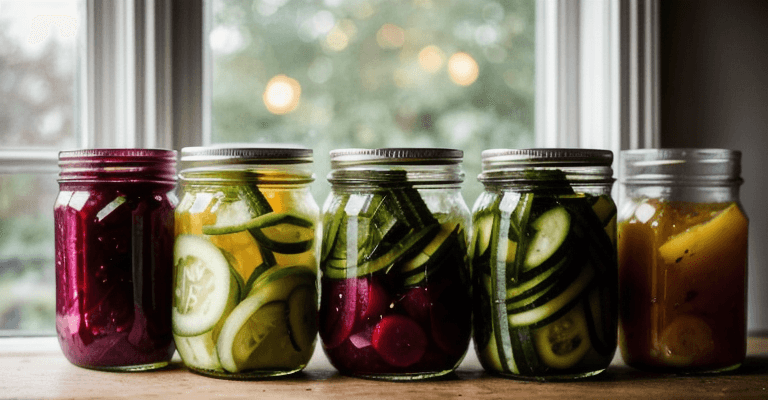
Pickling Brine Ratios — Vinegar Types, Salt Percentages, and Safety Chart
Quick pickle vs. fermented pickle — different processes, different ratios. Complete brine calculator with vinegar acidity requirements and shelf life expectations.
What Brine Ratio Ensures Safe Pickling Without Making Everything Taste Like Vinegar?
How do you calculate the acid concentration needed for safe preservation while keeping the flavor balanced? Too little acid and botulism risk increases. Too much and the product is inedible. This guide provides the brine ratio tables for different pickle types, pH safety thresholds, and the acid-salt-sugar balance formulas that let you adjust flavor without compromising safety.
Two types of pickling
“Pickling” describes two fundamentally different processes:
| Feature | Quick pickle (vinegar) | Fermented pickle (brine) |
|---|---|---|
| Acid source | Added vinegar | Produced by bacteria (lactic acid) |
| Time | 1–24 hours to edible | 3–14 days minimum |
| Shelf life (refrigerated) | 2–3 months | 6–12 months |
| Shelf life (canned) | 12+ months | Don’t can fermented pickles (kills probiotics) |
| Probiotic benefit | None | Yes — live Lactobacillus |
| Flavor | Sharp, clean, vinegar-forward | Complex, funky, deep sour |
| Texture | Crisp (if done right) | Can soften over time |
| Skill required | Minimal | Moderate (salt ratios, submersion, patience) |
Quick pickle master brine
The universal quick pickle formula:
| Component | Amount | Function |
|---|---|---|
| Vinegar (5% acidity minimum) | 1 cup (240ml) | Acid — preserves, flavors |
| Water | 1 cup (240ml) | Dilutes vinegar to palatable level |
| Salt | 1 tablespoon (15g) | Flavor, texture (draws water from vegetables) |
| Sugar | 1 tablespoon (optional) | Balances acidity. Omit for savory pickles |
This 1:1 vinegar-to-water ratio produces a brine with ~2.5% acetic acid — sufficient for preservation and pleasant to eat.
Safety rule: Never go below 50% vinegar in a quick pickle brine. Below that, pH may not drop enough to prevent pathogen growth, especially if canning.
Vinegar types and their acidity
| Vinegar | Acidity | Flavor | Best for |
|---|---|---|---|
| White distilled | 5% | Sharp, clean, no color | Universal. Lets vegetable flavor dominate |
| Apple cider | 5% | Mild, fruity, slightly sweet | Onions, carrots, beets, anything sweet-savory |
| White wine | 6% | Light, slightly sweet | Delicate vegetables, cornichons, pickled grapes |
| Red wine | 6–7% | Tannic, complex | Red onions, peppers, Mediterranean vegetables |
| Rice vinegar | 4–4.5% | Mild, sweet | Asian pickles (must use more to compensate lower acid) |
| Sherry vinegar | 7–8% | Deep, nutty, complex | Premium pickles, cocktail garnishes |
| Balsamic | 6% | Sweet, complex, dark | Not ideal for pickling (too sweet, too dark). Use for quick pickled onions only |
| Malt vinegar | 5% | Robust, malty | British-style pickled onions, chutneys |
Rice vinegar warning: At 4–4.5% acidity, rice vinegar is borderline for safe preservation. If using rice vinegar, increase the vinegar-to-water ratio to 2:1 (instead of 1:1) for safety, or use it only for quick pickles consumed within 2 weeks.
Flavor additions (per 1 cup brine)
| Category | Ingredients | Amount | Notes |
|---|---|---|---|
| Aromatics | Garlic cloves | 2–3 cloves, smashed | Universal. Add raw |
| Fresh dill | 2–3 sprigs | Classic dill pickle flavor | |
| Bay leaves | 1–2 | Subtle herbal depth | |
| Spices (whole) | Black peppercorns | 1 tsp | Universal warmth |
| Mustard seeds | 1 tsp | Slightly spicy, classic pickle spice | |
| Coriander seeds | 1 tsp | Citrusy, pairs with carrots | |
| Red pepper flakes | ½–1 tsp | Heat. Increases over time | |
| Cumin seeds | ½ tsp | Earthy, pairs with onions | |
| Fresh | Fresh chili (sliced) | 1 small | Builds heat gradually |
| Ginger (sliced) | 3–4 coins | Bright, Asian-forward pickles | |
| Turmeric (fresh, sliced) | 2–3 coins | Vivid yellow color, earthy | |
| Sweet | Honey or sugar | 1–2 tbsp | Sweet pickles, bread-and-butter style |
| Star anise | 1 whole | Licorice note, pairs with beets | |
| Cinnamon stick | 1 small | Warm spiced pickles |
Rule: Use whole spices, not ground. Ground spices cloud the brine and create gritty sediment.
Fermented pickle brine
For fermented pickles (not vinegar), you make a salt-water brine and let Lactobacillus produce the acid:
| Component | Amount | Notes |
|---|---|---|
| Water (non-chlorinated) | 1 liter | Tap water chlorine kills LAB. Use filtered or boil and cool |
| Salt (non-iodized) | 30–50g (3–5%) | 3% = milder, faster. 5% = saltier, crunchier, slower |
| Vegetables | Fill jar, submerge | Pack tightly to minimize air pockets |
| Grape leaves or oak leaves (optional) | 1–2 | Tannins help maintain crispness (pectin enzyme inhibition) |
Cucumber pickle tip: For crunchiest fermented pickles, add grape leaves (or horseradish leaves) — they contain tannins that inhibit pectinase enzymes, which otherwise soften the cucumber.
Brine strength reference
| Brine % | Salt per liter | Fermentation speed | Best for |
|---|---|---|---|
| 2% | 20g/L | Fast (3–5 days) | Quick ferments, mild flavor |
| 3% | 30g/L | Standard (5–10 days) | Sauerkraut, kimchi base |
| 3.5% | 35g/L | Standard (7–14 days) | Cucumber pickles (classic) |
| 5% | 50g/L | Slow (14–21 days) | Hot climates, long storage, olives |
| 10% | 100g/L | Very slow (weeks–months) | Preserved lemons, capers |
Texture control
| Factor | Crunchier | Softer |
|---|---|---|
| Salt % | Higher (3.5–5%) | Lower (2%) |
| Temperature | Cooler (15–20°C) | Warmer (25–30°C) |
| Fermentation time | Shorter | Longer |
| Additive | Grape/oak/horseradish leaf | None |
| Cut | Whole or halves | Thin slices |
| Vegetable freshness | Picked same day, cold | Days old, room temp |
Shelf life expectations
| Type | Refrigerated (opened) | Canned (sealed) | Counter (fermented, sealed) |
|---|---|---|---|
| Quick pickle (vinegar) | 2–3 months | 12+ months | Not safe — must refrigerate |
| Fermented pickle | 6–12 months | Not recommended (kills cultures) | 1–3 months if pH <4.0 and airlock used |
| Pickled eggs | 3–4 months | Not safe for home canning (density risk) | Not safe |
| Pickled peppers | 2–3 months | 12+ months | 3–6 months if fermented |
The economics
A jar of artisan pickled vegetables costs $8–15. A home batch:
- Vegetables: $2–4
- Vinegar: $0.30
- Spices: $0.20
- Time: 15 minutes (quick pickle), 15 minutes + 1–2 weeks waiting (fermented)
The skill compounds: once you have the brine ratio memorized and a jar of whole spices, you can pickle anything in your refrigerator that’s about to go past prime — onions, carrots, jalapeños, radishes, green beans. Zero food waste, always a condiment ready.
Quick Reference Summary
| Pickle type | Vinegar:Water ratio | Salt % | Target pH |
|---|---|---|---|
| Quick pickles | 1:1 (5% acidity vinegar) | 2-3% | <4.6 |
| Fermented pickles | No vinegar (lactic acid) | 3.5-5% | <4.6 (self-acidifying) |
| Bread & butter | 1:1 with sugar | 2% | <4.0 |
| Relish/chutney | 1:2 to 1:1 | 1-2% | <3.5 |
Safety rule: pH must be below 4.6 to prevent Clostridium botulinum growth. Test with pH strips or meter, not taste.
How to apply this
Use the recipe-scaler tool to adjust portions to scale ingredient quantities based on the data above.
Start with the reference tables above to identify the correct parameters for your specific ingredient or technique.
Measure your key variables (temperature, weight, time) before beginning — precision prevents waste.
Check the comparison tables to select the best approach for your situation and equipment.
Adjust quantities using the recipe-scaler when scaling up or down from the tested ratios.
Test with a small batch first, using the exact measurements from the tables before committing to full volume.
Verify your results against the expected outcomes listed in the quick reference section.
Honest Limitations
Brine ratios assume standard 5% acidity vinegar; vinegar acidity varies by type and brand — always check the label. Fermented pickle salt percentages are starting points; fermentation rate depends on temperature, salt purity, and vegetable water content. pH measurements require calibrated equipment; test strips have limited accuracy. This guide covers water-bath safe pickling; pressure canning for low-acid foods has different requirements. Altitude affects boiling point and processing times. Not a substitute for USDA Complete Guide to Home Canning for pressure canning protocols.
