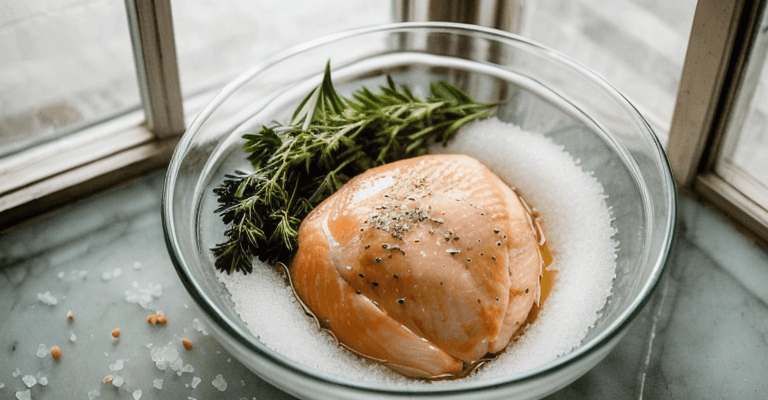
Brining Science — Wet Brine vs. Dry Brine, Ratios, and Timing
Osmosis, diffusion, and protein denaturation — the actual science behind brining. Complete salt ratios, timing tables by protein weight, and fixes for over-brined meat.
What Do You Actually Need to Know About Brining Science?
What are the common mistakes, the precise measurements, and the science-backed techniques that separate reliable results from guesswork? This guide provides the reference tables, ratio calculations, and decision frameworks for brining science — organized for quick lookup and practical application.
How brining actually works
Brining is not “soaking meat in salt water.” It is a two-phase process driven by osmosis and diffusion that restructures muscle proteins at a cellular level.
Phase 1 — Osmosis (first 15–30 minutes). Salt on the surface creates a hypertonic environment. Water inside muscle cells moves outward through semi-permeable cell membranes toward the higher salt concentration. This is why dry-brined meat initially looks wet — it is losing moisture, not gaining it.
Phase 2 — Diffusion and protein denaturation (30 minutes onward). Salt ions (Na⁺ and Cl⁻) diffuse inward through the meat. As chloride ions penetrate muscle fibers, they cause myosin proteins to partially denature and unwind. These unwound proteins trap and hold water molecules — both the meat’s original moisture and, in wet brining, additional water from the brine solution. The result is meat that retains 10–15% more moisture during cooking.
The salt penetration rate is approximately 1 inch per 24 hours in wet brine and slightly slower in dry brine. This rate varies with temperature, salt crystal size, and the density of the protein.
Wet brine vs. dry brine
Each method has trade-offs. Neither is universally better.
| Factor | Wet brine | Dry brine |
|---|---|---|
| Salt ratio | 5–8% salt by water weight | 0.5–1% salt by meat weight |
| Typical formula | 50g salt per 1L water | 5–10g salt per 1kg meat |
| Moisture gain | +10–15% (absorbed water) | +0% (retains original moisture) |
| Skin result (poultry) | Soft, needs air-drying | Crisp, skin dries naturally |
| Fridge space | Large container needed | Fits on a sheet tray |
| Flavor concentration | Slightly diluted (added water) | Concentrated (no added water) |
| Sugar/aromatics | Dissolve easily in liquid | Must be ground and mixed with salt |
| Best for | Lean cuts, turkey, pork loin | Chicken, steaks, skin-on poultry |
| Risk of over-brining | Higher (full submersion) | Lower (surface application) |
Wet brine master formula
The standard wet brine concentration is 5% by weight: 50 grams of kosher salt per liter of water. For a sweeter brine (good for pork and poultry), add 25 grams of sugar per liter. Always dissolve salt and sugar in warm water first, then cool the brine to below 4°C (40°F) before adding protein. Never brine at room temperature — the danger zone (4–60°C) invites bacterial growth.
For equilibrium brining (a more precise method used in charcuterie), calculate based on the total weight of meat plus water combined. Use 2% of that total weight in salt. The meat reaches the same salinity as the liquid over 24–48 hours and cannot over-brine.
Dry brine formula
Apply 1 teaspoon (6g) of kosher salt per pound (450g) of meat, distributed evenly over all surfaces. Place on a wire rack over a sheet tray, uncovered, in the refrigerator. The uncovered rest simultaneously dry-brines and air-dries the surface — critical for crisp poultry skin or a hard sear on steak.
Timing table by protein and weight
Under-brining wastes time. Over-brining creates inedibly salty, mushy meat. Use this table for standard 5% wet brine at 2–4°C.
| Protein | Weight | Wet brine time | Dry brine time |
|---|---|---|---|
| Shrimp (shell-on) | Any | 15–20 min | Not recommended |
| Boneless chicken breast | 170–230g | 30–60 min | 1–4 hours |
| Bone-in chicken thigh | 140–200g | 1–2 hours | 4–12 hours |
| Whole chicken | 1.5–2.5 kg | 4–8 hours | 12–24 hours |
| Pork chops (2.5cm thick) | 200–280g | 1–2 hours | 2–6 hours |
| Pork tenderloin | 400–600g | 2–4 hours | 6–12 hours |
| Whole turkey (5–7 kg) | 5–7 kg | 12–18 hours | 24–48 hours |
| Whole turkey (7–10 kg) | 7–10 kg | 18–24 hours | 48–72 hours |
| Salmon fillet (2.5cm thick) | 170–230g | 20–30 min | 30–60 min |
| Pork shoulder | 2–4 kg | 12–24 hours | 24–48 hours |
Critical rule: Never brine already-injected or “enhanced” supermarket meat. Check the label — if sodium content exceeds 80mg per serving, the processor already added salt solution. Brining on top of that creates inedible results.
Equilibrium brining — the precision method
Traditional brining uses excess salt and relies on removing the protein at the right time. Equilibrium brining uses math instead of a timer.
The calculation: Weigh the meat. Weigh the water (enough to submerge). Add the two weights. Multiply the total by your target salinity — typically 0.015 to 0.02 (1.5–2%). That number is your salt weight.
Example: 2 kg pork loin + 2 kg water = 4 kg total. At 1.75% salinity: 4000g × 0.0175 = 70g salt.
The protein reaches equilibrium with the brine over 24–48 hours and then stops absorbing salt. You can leave it for 72 hours without over-brining. This method is forgiving, precise, and used by professional charcutiers for cured meats, gravlax, and bacon.
Fixing over-brined meat
If the protein tastes too salty after brining, you have options depending on severity.
Mild over-brining (slightly too salty). Soak the protein in plain cold water for 30 minutes. The same diffusion process that drove salt in will drive it back out toward the lower-concentration water. Change the water halfway through.
Moderate over-brining (noticeably salty). Soak in cold water for 1–2 hours, changing the water every 30 minutes. Then pat dry and rest uncovered in the fridge for 2–4 hours. The extended rest allows salt to redistribute evenly rather than concentrating at the surface.
Severe over-brining (mushy texture). If the texture has gone mushy — meaning myosin proteins have denatured too far — soaking won’t fully fix it. The best recovery: slice or shred the protein thin, use it in a dish where you control the salt of everything else (salad, fried rice, tacos), and skip adding any additional salt to the dish.
Prevention formula: When in doubt, brine at 3% concentration (30g per liter) instead of 5%. It takes roughly 50% longer to reach the same result, but the margin for error is much wider. Or switch to equilibrium brining entirely.
Salt type matters
Not all salt measures the same. One tablespoon of different salts contains dramatically different amounts of sodium chloride due to crystal size and shape.
| Salt type | Weight per tablespoon | Notes |
|---|---|---|
| Morton kosher salt | 15g | Coarse flakes, slower dissolve |
| Diamond Crystal kosher | 9g | Hollow flakes, faster dissolve |
| Fine table salt | 18g | Dense crystals, easy to over-salt |
| Fine sea salt | 17g | Similar to table salt by weight |
| Maldon flaky sea salt | 8g | Finishing salt, not for brining |
Always measure brine salt by weight, not volume. A recipe calling for “1/4 cup kosher salt” could mean 36g (Diamond Crystal) or 60g (Morton) — a 67% difference that will ruin your results. A kitchen scale eliminates this variable entirely.
The bottom line: brining is applied chemistry. Understand osmosis, measure by weight, match timing to thickness, and you will produce juicier protein every single time — no guesswork required.
Brine concentration effects
The salt percentage in your brine determines not just saltiness but the structural changes in the protein. Higher concentrations work faster but carry higher risk of over-brining. Lower concentrations are more forgiving but require longer exposure.
| Salt % (by water weight) | Effect on Protein | Texture Result | Best For | Time Range |
|---|---|---|---|---|
| 1–2% | Minimal myosin denaturation; surface seasoning only | Barely perceptible change; slight moisture retention | Delicate fish fillets, shrimp | 15–30 minutes |
| 3% | Moderate myosin unfolding; 5–8% moisture gain | Noticeably juicier; natural texture preserved | Chicken breast, pork chops, salmon | 1–4 hours |
| 5% (standard) | Significant myosin denaturation; 10–15% moisture gain | Juicy, plump; slightly firmer bite from protein restructuring | Whole chicken, turkey, pork loin | 4–18 hours |
| 8% | Aggressive protein denaturation; 12–18% moisture gain | Firm, almost ham-like texture; distinctly salty surface | Corned beef, pastrami-style preparations | 3–7 days |
| 10% | Near-complete myosin unfolding; cellular structure altered | Dense, cured texture; requires soaking before cooking | Gravlax, salt cod, bacon | 2–14 days |
| 20–26% (saturated) | Full protein denaturation; water activity drops below bacterial growth threshold | Preserved, shelf-stable; requires extensive desalination | Traditional salt preservation, salt pork, baccala | Weeks to months |
The transition between 3% and 5% is where most home cooks should operate. Below 3%, the effect is too subtle to justify the time investment. Above 5%, you enter curing territory where precise timing becomes critical and the margin for error shrinks dramatically.
Equilibrium brining at 1.5–2% total weight (meat + water combined) produces results equivalent to traditional 5% brining but with a wider forgiveness window. The protein reaches the same salinity as the surrounding liquid and mathematically cannot over-brine. For home cooks who struggle with timing, equilibrium brining eliminates the single most common failure mode.
What brining can’t fix
Brining is powerful but not universal. Several limitations are frequently overlooked in guides that present brining as a solution to all dry-protein problems.
Overbrining is irreversible at the texture level. You can soak over-brined meat in fresh water to extract excess salt, and this does reduce saltiness noticeably. But the protein denaturation that caused the mushy, ham-like texture cannot be undone. Once myosin proteins have unfolded past a certain threshold, they cannot refold into their original structure. The meat will remain unnaturally dense and springy regardless of desalination. Prevention (accurate salt measurement and timing) is the only reliable strategy.
Low-quality protein will not benefit meaningfully. Brining adds moisture to muscle fibers, but it cannot create tenderness in inherently tough cuts. A well-brined flank steak is juicier but still chewy if not sliced against the grain. A brined chicken breast from a factory-farmed bird gains moisture but not the flavor depth of a heritage-breed bird that was never brined. Brining compensates for moisture loss during cooking — it does not upgrade the protein itself.
The salt-flavor ceiling is real. Beyond approximately 1.5% internal salt concentration (which corresponds to a 5% wet brine for the standard timing), additional salt does not improve flavor — it overwhelms it. Well-brined meat tastes seasoned throughout. Over-brined meat tastes like salt. There is no “extra juicy” level above proper brining — only “too salty.” Cooks who double brine times or concentrations hoping for better results consistently produce worse outcomes.
Food safety time limits at room temperature are non-negotiable. Brine that sits above 4°C (40°F) enters the danger zone where bacteria double every 20 minutes. A whole turkey in a brine bucket on the counter for “just a few hours” can develop dangerous bacterial loads long before the salt penetrates deep enough to inhibit growth. The salt concentration in a standard 5% brine is not high enough to prevent bacterial growth at room temperature — only refrigeration provides that safety margin. Always brine below 4°C, and if the protein plus brine does not fit in your refrigerator, use a cooler packed with ice and monitor the temperature hourly.
Quick Reference Summary
| Brine type | Salt concentration | Duration | Best for |
|---|---|---|---|
| Light wet brine | 3-5% (30-50g/L) | 1-4 hours | Chicken breasts, fish fillets |
| Standard wet brine | 5-8% (50-80g/L) | 4-12 hours | Whole chicken, pork chops |
| Heavy wet brine | 8-10% (80-100g/L) | 12-24 hours | Turkey, pork shoulder |
| Dry brine | 0.5-1% of meat weight | 12-48 hours | Steaks, roasts, poultry |
| Equilibrium brine | 1.5-2% of total weight | 24-72 hours | Precision results, any protein |
Decision rule: Dry brine for crispy skin (no surface moisture). Wet brine for maximum juiciness in lean cuts. Equilibrium brine when you need precision and can wait.
How to apply this
Use the recipe-scaler tool to adjust portions to scale ingredient quantities based on the data above.
Start with the reference tables above to identify the correct parameters for your specific ingredient or technique.
Measure your key variables (temperature, weight, time) before beginning — precision prevents waste.
Check the comparison tables to select the best approach for your situation and equipment.
Adjust quantities using the recipe-scaler when scaling up or down from the tested ratios.
Test with a small batch first, using the exact measurements from the tables before committing to full volume.
Verify your results against the expected outcomes listed in the quick reference section.
Honest Limitations
Brining effectiveness depends on meat thickness, temperature, and salt type (kosher vs. table salt have different densities — 1 cup kosher ≠ 1 cup table). Over-brining produces salty, mushy texture that cannot be reversed. Sugar, aromatics, and acids in brine affect flavor but not the core salt-diffusion mechanism. This guide covers sodium chloride brining; curing with nitrates/nitrites (Prague powder) is a separate process with different safety considerations. Equilibrium brining times assume refrigerator temperature (4°C); warmer temperatures increase bacterial risk.
