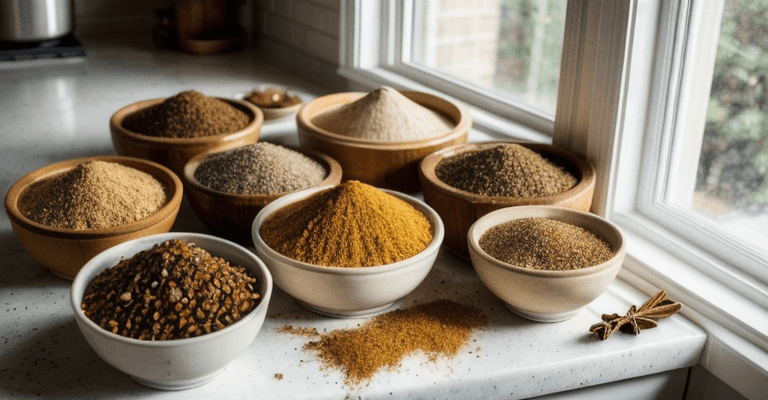
Mise en Place — Why Prep Order Matters More Than the Recipe
Professional kitchen workflow adapted for home cooking. Timing cascades, station setup, and the heat-first-cut-second principle that separates chaotic cooking from controlled cooking.
What Do You Actually Need to Know About Mise en Place?
What are the common mistakes, the precise measurements, and the science-backed techniques that separate reliable results from guesswork? This guide provides the reference tables, ratio calculations, and decision frameworks for mise en place — organized for quick lookup and practical application.
What mise en place actually means
Mise en place is French for “putting in place.” In professional kitchens, it is not a suggestion — it is the operational system that makes service possible. A line cook who starts cooking without complete mise en place gets fired. Not warned. Fired.
The concept goes beyond “chop your onions before you start.” True mise en place is a sequenced workflow where every element is prepped, portioned, and positioned so that cooking becomes pure assembly. The thinking is done before the heat goes on. Once flame hits pan, there is no time to dice, measure, or search for ingredients.
Home cooks skip mise en place because they think it adds time. The opposite is true. A stir-fry with proper mise en place takes 12 minutes total — 8 minutes of prep, 4 minutes of cooking. The same stir-fry without mise en place takes 25 minutes because you are pausing mid-cook to slice vegetables while your garlic burns, your wok temperature drops, and your noodles overcook.
The heat-first-cut-second principle
This is the single most important sequencing rule. Before you touch a knife, identify everything in the recipe that needs to preheat, and start those processes first. Preheating is dead time if you are standing around watching, but productive time if you are prepping while things heat.
Start these before any cutting:
- Oven — takes 10–20 minutes to reach temperature. Turn it on first, always.
- Water for boiling — a large pot takes 8–12 minutes. Start the water.
- Proteins to room temperature — pull from fridge immediately. A 2.5cm steak needs 20–30 minutes to temper.
- Butter to soften — if baking, pull butter when you start.
- Cast iron or heavy pans — preheat over medium 3–5 minutes for even heat distribution.
Only after these are started do you begin cutting, measuring, and portioning. By the time your prep is done, your equipment is at temperature and you can begin cooking with zero dead time.
Station setup for home kitchens
Professional kitchens organize into stations. Home kitchens can use a simplified version with three zones.
| Zone | Contents | Position |
|---|---|---|
| Prep zone | Cutting board, knife, peeler, measuring tools, scrap bowl | Counter space away from stove |
| Staging zone | Small bowls/plates with prepped ingredients, grouped by cook-time | Between prep zone and stove |
| Cook zone | Stove, hot pans, spatulas, tongs, serving plates | Stovetop and immediate area |
The scrap bowl is the most underrated tool in a home kitchen. A large bowl next to your cutting board for peels, ends, stems, and packaging. Without it, you make 15 trips to the trash can during prep. With it, you make one trip at the end.
Grouping by cook-time is what separates amateur mise en place from professional mise en place. Do not just prep everything and leave it scattered. Group ingredients that go into the pan at the same time onto the same plate or into the same bowl.
Example for a stir-fry:
- Bowl 1: garlic + ginger + scallion whites (hit the oil first, 15 seconds)
- Bowl 2: hard vegetables — carrots, broccoli stems (2–3 minutes cook time)
- Bowl 3: soft vegetables — bell peppers, snap peas, bok choy leaves (1 minute cook time)
- Small cup: sauce mixture, pre-whisked
- Plate: protein, sliced and seasoned
When it is time to cook, you grab bowls in order. No thinking. No scrambling.
Timing cascades — working backward from the plate
A timing cascade means planning backward from the moment food hits the table. Everything should finish at the same time. This is the skill that separates a calm cook from a frantic one.
The method: Write down every component of the meal and its cook time. Work backward from serving time.
| Time (minutes before serve) | Action | Component |
|---|---|---|
| –45 | Start oven, pull steak from fridge | Oven, steak temper |
| –35 | Wash and prep all vegetables | All vegetables |
| –25 | Put potatoes in oven | Roasted potatoes (25 min at 220°C) |
| –20 | Mix salad dressing, wash greens | Salad |
| –15 | Preheat cast iron pan | Steak pan |
| –10 | Sear steak (4 min per side) | Steak |
| –6 | Start steaming green beans | Green beans (6 min) |
| –2 | Rest steak, plate potatoes | Steak rest |
| 0 | Slice steak, assemble all plates | Service |
Notice how nothing overlaps dangerously. The oven does its job unattended while you prep. The steak rests while green beans finish. The potatoes are done before the steak needs the oven space.
The most common timing mistake: Starting everything at the same time. This creates a pileup at the end where three things need attention simultaneously. Instead, stagger start times so that you never manage more than two active tasks at once.
Prep categories and shelf life
Not all mise en place needs to happen right before cooking. Some prep can be done hours or even days ahead.
| Prep type | Do ahead? | Storage | Notes |
|---|---|---|---|
| Dice onions | Up to 2 days | Airtight container, fridge | Flavor intensifies with time (sulfur compounds) |
| Mince garlic | Same day only | Covered, fridge | Oxidizes and turns bitter after 4–6 hours |
| Slice mushrooms | Same day | Paper towel-lined container | Browning is cosmetic only, not harmful |
| Chop herbs | Same day for soft herbs; 2 days for hardy | Damp paper towel, sealed bag | Basil, cilantro, parsley bruise and darken quickly |
| Juice citrus | Up to 3 days | Sealed jar, fridge | Flavor fades slightly, still usable |
| Mix dry spice blends | Weeks ahead | Airtight jar, cool/dark | Actually improves as flavors meld |
| Portion proteins | 1 day ahead | Fridge, wrapped | Pat dry again before cooking |
| Pre-make sauces | 2–5 days | Sealed container, fridge | Many sauces improve over 24 hours |
| Toast and grind spices | Up to 1 week | Airtight jar | Volatile compounds fade after 7–10 days |
| Wash and dry greens | Up to 3 days | Salad spinner, towel-lined container | Must be completely dry |
The professional cleanup-as-you-go rule
Mise en place includes cleaning. In a professional kitchen, a dirty station is a disorganized station, and disorganization during service is failure.
The home version: When something goes into the oven or into a pan that does not need stirring, you have 2–5 minutes of idle time. Use that time to wash the cutting board, rinse the prep bowls, wipe down your staging area. By the time food is plated, your kitchen should be 80% clean already.
This is not about neatness for its own sake. It is about keeping your workspace functional. A cluttered counter means you have nowhere to set a hot pan. A full sink means you cannot quickly rinse a colander. Every dirty dish you clear during cooking is one fewer obstacle between you and a smooth workflow.
Applying this to any recipe
Read the entire recipe before doing anything. Then rewrite it as a prep list and a cook list — two separate sequences.
Prep list (do this with the stove off): everything that involves cutting, measuring, mixing, marinating, or portioning. Group by shared cook-time as described above.
Cook list (do this with the stove on): the actual cooking steps, which should now be simple and fast because everything is pre-portioned and staged.
A 20-step recipe usually becomes 12 steps of prep and 8 steps of cooking. The 12 prep steps are calm, low-stakes, and can be paused. The 8 cooking steps are fast, focused, and require your full attention. Mise en place is the system that keeps those two phases separate — and that separation is what makes every recipe manageable.
Prep time estimates by dish complexity
How long mise en place actually takes depends on the dish. These estimates are based on an average home cook with a sharp knife and basic equipment. Professional cooks cut these times by 30-50%.
| Dish Complexity | Ingredients Count | Estimated Prep Time | Mise en Place Time | Cooking Time | Total Time |
|---|---|---|---|---|---|
| Simple (scrambled eggs, pasta aglio e olio) | 3-5 | 5 min | 2 min | 8-12 min | 15-19 min |
| Easy (stir-fry, basic soup, fried rice) | 6-10 | 12-15 min | 5 min | 10-15 min | 27-35 min |
| Moderate (curry, risotto, pan-seared protein + 2 sides) | 10-15 | 20-25 min | 8-10 min | 25-35 min | 53-70 min |
| Complex (lasagna, beef bourguignon, multi-component plated dinner) | 15-25 | 30-45 min | 12-15 min | 45-90 min | 87-150 min |
| Restaurant-complex (tasting menu course, composed dessert, multi-sauce dish) | 25-40 | 60-90 min | 20-30 min | 30-60 min | 110-180 min |
Mise en place time (column 4) is separate from prep time (column 3). Prep time is cutting, measuring, and mixing. Mise en place time is the overhead of organizing those prepped ingredients into cook-time groups, staging them by the stove, and setting up your workspace. For simple dishes, this overhead is negligible. For complex dishes, the 15-30 minutes of mise en place organization saves 20-40 minutes of mid-cook scrambling and prevents the burned-garlic-while-dicing-onions disaster.
Mise en place efficiency table
Not all mise en place techniques deliver equal returns. Some save significant time every session; others only matter for complex meals.
| Technique | Time Saved Per Session | Equipment Needed | Difficulty |
|---|---|---|---|
| Scrap bowl on cutting board | 3-5 min (eliminates 10-15 trips to trash) | Any large bowl | Trivial — just place it |
| Cook-time grouping (ingredients on shared plates) | 5-10 min (eliminates mid-cook searching and measuring) | Small bowls, ramekins, or plates | Easy — requires reading recipe fully first |
| Batch-prep aromatics (mince garlic, ginger, shallots for the week) | 15-20 min per week (amortized across 4-5 meals) | Airtight containers, fridge space | Easy — garlic keeps 2 days, ginger keeps 5 |
| Pre-mix dry spice blends (taco, curry, stir-fry) | 2-3 min per meal (eliminates measuring 4-6 jars each time) | Small jars or bags | Easy — mix once, use 8-10 times |
| Reverse-engineering the recipe (writing separate prep and cook lists) | 8-15 min (eliminates re-reading recipe mid-cook) | Paper or phone | Moderate — requires understanding cook times |
| Timing cascade planning (working backward from plate) | 10-20 min (eliminates the “everything finishes at different times” problem) | Paper, clock | Moderate-hard — requires experience estimating cook times |
The highest ROI technique for beginners is the scrap bowl — zero skill required, immediate payoff. The highest ROI technique for experienced cooks is timing cascade planning — it transforms a stressful multi-component dinner into a calm, sequential operation.
When mise en place is overkill
Simple one-pot meals. A pot of chili, a basic soup, or a one-pan pasta needs 4-6 ingredients that all go into the same vessel within minutes of each other. Full mise en place staging — separate bowls, cook-time grouping, timing cascade — adds 10 minutes of setup to a dish that only has 5 minutes of active cooking. For these meals, just chop and add as you go.
Baking where ingredients go in sequentially. A muffin recipe that says “mix dry, mix wet, combine” does not benefit from staging 8 separate ramekins of measured ingredients. The recipe is already sequenced. Measure flour into a bowl, measure sugar into the same bowl, add baking powder. The recipe’s instructions ARE the mise en place. Re-staging them into a professional kitchen layout adds time without reducing errors.
The overhead for 15-minute weeknight dinners. If the total cook time is under 15 minutes (scrambled eggs, quesadillas, toast with toppings, simple fried rice), the mise en place setup time can exceed the cooking time. At that point, the organizational overhead defeats its own purpose. The rule of thumb: if the dish has fewer than 6 ingredients and takes under 15 minutes, mise en place formality is unnecessary. Just cook.
Quick Reference Summary
| Prep category | When to do it | Why it matters |
|---|---|---|
| Read entire recipe | Before any prep | Identifies total time, equipment, and sequencing |
| Measure dry ingredients | First | Stable — won’t degrade while waiting |
| Chop aromatics (onion, garlic) | Second | Volatile compounds diminish over 15-30 min |
| Prep proteins (cut, season) | Third | Allows tempering to room temperature |
| Measure liquids | Last before cooking | Some (buttermilk, citrus juice) are time-sensitive |
| Heat pan/oven | Concurrent with final prep | Equipment reaches temperature when you need it |
Decision rule: Prep everything that goes into the pan within the first 2 minutes of cooking BEFORE turning on the heat. Stir-fry mise en place is non-negotiable — ingredients cook in 30-60 seconds each.
How to apply this
Use the recipe-scaler tool to adjust portions to scale ingredient quantities based on the data above.
Start with the reference tables above to identify the correct parameters for your specific ingredient or technique.
Measure your key variables (temperature, weight, time) before beginning — precision prevents waste.
Check the comparison tables to select the best approach for your situation and equipment.
Adjust quantities using the recipe-scaler when scaling up or down from the tested ratios.
Test with a small batch first, using the exact measurements from the tables before committing to full volume.
Verify your results against the expected outcomes listed in the quick reference section.
Honest Limitations
Mise en place adds 15-30 minutes of prep time before cooking starts — for simple weeknight meals, this overhead may not be justified. The approach assumes sufficient counter space and prep bowls; small kitchens require adaptation. Some ingredients degrade when prepped early (cut avocado browns, salted vegetables release water, whipped cream deflates). Professional mise en place in restaurant kitchens is maintained by prep cooks throughout service — home cooks do it once per meal. This guide covers the principle; specific mise en place for individual cuisines (sushi, pastry, wok cooking) has specialized requirements.
