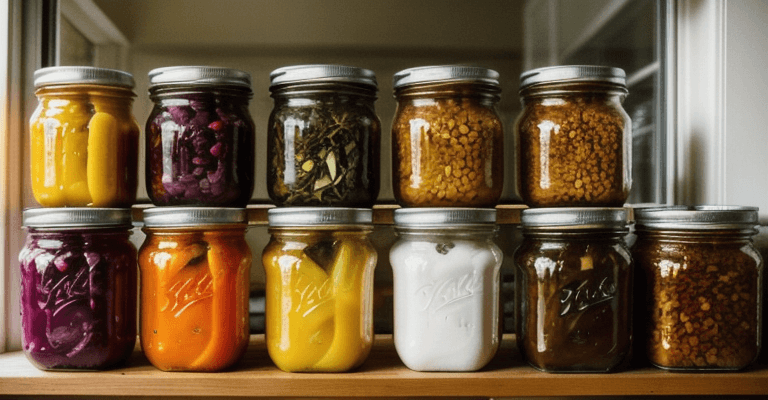
Canning and Preserving Safely — Pressure vs. Water Bath, the pH 4.6 Rule, and Every Processing Time You Need
The pH 4.6 rule that separates safe from deadly. Complete processing times for 30+ foods, altitude adjustment tables, pressure canner vs water bath decision matrix, equipment comparison, and the botulism science that makes this non-negotiable.
The pH 4.6 dividing line — why this number is non-negotiable
What does this actually mean in practice, and when does it matter?
This single number determines whether you can water-bath can a food or must use a pressure canner. At pH 4.6 and below, the environment is too acidic for Clostridium botulinum spores to germinate and produce toxin. Above pH 4.6, botulism becomes a real risk unless the food reaches 116C (240F) — achievable only under pressure.
C. botulinum spores survive 100C boiling water indefinitely. They are among the most heat-resistant biological structures on Earth. The toxin they produce (botulinum toxin) is the most lethal substance known — the lethal dose for a 70kg human is approximately 1.3-2.1 nanograms per kilogram of body weight. This is not a margin-of-error situation.
| Food Category | Typical pH Range | Method Required | Safety Margin |
|---|---|---|---|
| Vinegar pickles | 2.5-3.5 | Water bath | Large — well below 4.6 |
| Citrus fruits, berries | 2.0-3.5 | Water bath | Large |
| Stone fruits (peaches, plums) | 3.3-4.0 | Water bath | Moderate |
| Apples, apple sauce | 3.3-3.9 | Water bath | Moderate |
| Tomatoes (ripe) | 4.0-4.7 | Water bath + mandatory acidification | Narrow — some varieties cross 4.6 |
| Fermented foods (sauerkraut, kimchi) | 3.0-3.5 | Water bath | Large |
| Salsa (vinegar-based recipe) | 3.5-4.2 | Water bath (only tested recipes) | Moderate |
| Figs | 4.6-5.0 | Water bath + acidification | Borderline — treat as low-acid |
| Green beans, peas | 5.0-6.5 | Pressure canner only | None — high risk without pressure |
| Corn | 5.9-7.3 | Pressure canner only | None |
| Carrots | 4.9-5.2 | Pressure canner only | None |
| Meat, poultry, fish | 5.5-6.5 | Pressure canner only | None |
| Soups with low-acid vegetables | 5.0-6.5 | Pressure canner only | None |
| Dairy | 6.4-6.8 | Cannot be safely home-canned | — |
The tomato danger zone: Tomato pH ranges from 4.0 to 4.7 depending on variety, ripeness, growing conditions, and soil. The USDA requires acidification for all home-canned tomatoes: 2 tablespoons bottled lemon juice (not fresh — inconsistent pH) or 1/2 teaspoon citric acid per quart. Bottled lemon juice has a standardized pH of 2.0-2.4. Fresh lemon juice varies from 2.0-2.6.
Water bath canning — complete processing times
Water bath canning works by heating filled jars to 100C (212F) in boiling water. The heat destroys vegetative bacteria, yeasts, and molds. The vacuum seal formed during cooling prevents recontamination.
| Food | Pack Method | Jar Size | Processing Time (sea level) |
|---|---|---|---|
| Dill pickles (whole) | Raw pack | Quart | 15 minutes |
| Bread-and-butter pickles | Hot pack | Pint | 10 minutes |
| Peaches (syrup pack) | Hot pack | Quart | 30 minutes |
| Peaches (syrup pack) | Hot pack | Pint | 25 minutes |
| Pears (syrup pack) | Hot pack | Quart | 25 minutes |
| Apple sauce | Hot pack | Quart | 20 minutes |
| Apple butter | Hot pack | Pint | 10 minutes |
| Strawberry jam | Hot pack | Half-pint | 10 minutes |
| Grape jelly | Hot pack | Half-pint | 10 minutes |
| Grape juice | Hot pack | Quart | 15 minutes |
| Tomatoes (acidified, whole/halved) | Hot pack | Quart | 45 minutes |
| Tomatoes (acidified, whole/halved) | Raw pack | Quart | 85 minutes |
| Tomato sauce (acidified) | Hot pack | Quart | 35 minutes |
| Sauerkraut | Hot pack | Quart | 15 minutes |
| Pickled beets | Hot pack | Pint | 30 minutes |
| Pickled peppers | Raw pack | Pint | 10 minutes |
| Salsa (tested recipe only) | Hot pack | Pint | 15 minutes |
Critical rules:
- Start timing only when water returns to a full rolling boil after jars are submerged
- Jars must be covered by at least 2.5cm (1 inch) of water throughout processing
- Never reduce processing time — USDA tested times account for heat penetration to the geometric center of the jar
- Hot pack (pre-heated food into hot jars) is safer and produces better results than raw pack for most foods — fewer air bubbles, better headspace management
Pressure canning — the thermal kill science
Pressure canning raises the boiling point above 100C. At 10 PSI gauge pressure (69 kPa), water boils at 116C (240F). At 15 PSI (103 kPa), it reaches 121C (250F). These temperatures destroy C. botulinum spores — the only reliable kill method for low-acid foods.
Why pressure matters — thermal death time data:
| Target Organism | Temperature Required | Time at Temperature | Achieved By |
|---|---|---|---|
| Vegetative bacteria (E. coli, Salmonella) | 74C (165F) | Seconds | Normal cooking |
| Yeasts and molds | 100C (212F) | 5-10 minutes | Water bath canning |
| C. botulinum toxin (pre-formed) | 85C (185F) | 5 minutes | Boiling (detoxifies but doesn’t kill spores) |
| C. botulinum spores | 116C (240F) | 20-100 minutes depending on food | Pressure canning only |
| C. botulinum spores at 100C | Survive indefinitely | Not achievable | — |
Pressure canner settings:
| Pressure Setting | Temperature Reached | Use Case |
|---|---|---|
| 5 PSI (34 kPa) | 109C (228F) | Not sufficient for canning — cannot kill spores |
| 10 PSI (69 kPa) | 116C (240F) | Standard for low-acid foods at sea level |
| 15 PSI (103 kPa) | 121C (250F) | Required at high altitude; also used for faster processing |
Pressure canning processing times:
| Food | Jar Size | Time at 10 PSI (sea level) |
|---|---|---|
| Green beans | Quart | 25 minutes |
| Corn (whole kernel) | Pint | 55 minutes |
| Carrots | Quart | 30 minutes |
| Chicken (bone-in pieces) | Quart | 75 minutes |
| Beef stew meat (cubes) | Quart | 75 minutes |
| Fish (in oil or brine) | Half-pint | 100 minutes |
| Vegetable soup (no meat) | Quart | 40 minutes |
| Chili with meat | Quart | 75 minutes |
| Bone broth | Quart | 25 minutes |
Altitude adjustment — mandatory, not optional
At higher elevations, atmospheric pressure is lower, so the boiling point drops. You must compensate.
Water bath adjustment:
| Altitude | Additional Processing Time |
|---|---|
| 0-300m (0-1,000 ft) | Baseline (no adjustment) |
| 300-900m (1,001-3,000 ft) | +5 minutes |
| 900-1,800m (3,001-6,000 ft) | +10 minutes |
| Above 1,800m (6,000+ ft) | +15 minutes |
Pressure canner adjustment:
| Altitude | Dial Gauge | Weighted Gauge |
|---|---|---|
| 0-300m (0-1,000 ft) | 10 PSI | 10 PSI |
| 300-600m (1,001-2,000 ft) | 11 PSI | 15 PSI |
| 600-1,200m (2,001-4,000 ft) | 12 PSI | 15 PSI |
| 1,200-1,800m (4,001-6,000 ft) | 13 PSI | 15 PSI |
| Above 1,800m (6,000+ ft) | 14-15 PSI | 15 PSI |
Weighted gauges only have 5, 10, and 15 PSI settings — if any adjustment is needed, you must jump to 15 PSI. Dial gauges offer incremental adjustment but must be calibrated annually (county extension offices do this for free in most US states).
Equipment comparison
| Equipment | Cost Range | Acid Foods | Low-Acid Foods | Altitude Adjustment | Maintenance |
|---|---|---|---|---|---|
| Large stockpot + rack | $30-60 | Yes (water bath) | No | Add processing time | None |
| Dedicated water bath canner | $40-80 | Yes | No | Add processing time | None |
| Dial gauge pressure canner | $90-200 | Yes (but overkill) | Yes | Incremental PSI adjustment | Annual gauge calibration |
| Weighted gauge pressure canner (All American) | $250-400 | Yes | Yes | 10 or 15 PSI only | Gasket replacement every 2-3 years |
| Electric pressure canner (validated models only) | $200-350 | Yes | Yes (only USDA-validated models) | Automatic | Replace seals per manual |
Critical distinction: An electric pressure cooker (Instant Pot) is NOT a validated pressure canner for low-acid foods unless the specific model has been tested and approved by the USDA or NCHFP. The pressure profiles and venting behavior differ from traditional canners. Using an unvalidated device for low-acid canning risks botulism.
Common canning mistakes and their consequences
| Mistake | Risk Level | Consequence | How Often It Happens |
|---|---|---|---|
| Using untested recipes from social media | Critical | pH may exceed 4.6; botulism risk | Very common — #1 cause of home canning illness |
| Reducing vinegar in pickle recipes | Critical | pH rises above safe threshold | Common — people find pickles “too sour” |
| Water bath canning low-acid foods | Critical | Botulism | Occurs yearly in USDA reports |
| Not acidifying tomatoes | High | Some varieties exceed pH 4.6 | Common |
| Processing at wrong altitude | Moderate | Insufficient thermal kill | Common in mountain regions |
| Over-tightening lids (too tight) | Low-moderate | Jars don’t vent properly during processing, lids buckle | Very common |
| Reusing lids (non-reusable type) | Moderate | Seal failure → spoilage | Common |
| Skipping headspace measurement | Low-moderate | Seal failure or food siphoning out | Common |
Seal testing and storage
After processing, remove jars and let them cool undisturbed for 12-24 hours. Test each seal:
The press test: Push the center of the lid. If it doesn’t flex or click, the seal is good. If it flexes, the jar didn’t seal.
The lift test (after 24 hours): Remove the band and lift the jar by the lid edge. A properly sealed lid holds the full weight of the jar. If it separates, the seal failed.
Failed seal protocol: Refrigerate and consume within 2 weeks, or reprocess within 24 hours using a new lid. After 24 hours, discard — you cannot reprocess.
Storage: Cool (10-21C / 50-70F), dark, dry. Properly sealed jars maintain safety for years, but quality is best within 12-18 months. Beyond that, color, texture, and nutritional value decline while safety is maintained as long as the seal holds.
The discard-without-tasting rule
Discard without opening or tasting if: The lid is bulging, liquid is cloudy (in foods that should be clear), there’s foam inside the jar, food spurts when opened, unusual odor, mold visible, or the jar was stored above 35C.
Botulinum toxin is odorless, colorless, and tasteless in many food matrices. Visual inspection alone is insufficient for low-acid foods. The microbiology of botulinum spore germination shows that toxin production can occur without visible signs of spoilage. When in doubt, discard. The cost of a jar of green beans is not worth the risk of a disease with a 5-10% fatality rate even with modern antitoxin treatment.
How to apply this
Use the recipe-scaler tool to adjust portions to scale ingredient quantities based on the data above.
Start with the reference tables above to identify the correct parameters for your specific ingredient or technique.
Measure your key variables (temperature, weight, time) before beginning — precision prevents waste.
Check the comparison tables to select the best approach for your situation and equipment.
Adjust quantities using the recipe-scaler when scaling up or down from the tested ratios.
Test with a small batch first, using the exact measurements from the tables before committing to full volume.
Verify your results against the expected outcomes listed in the quick reference section.
Honest limitations
What this guide does not cover: commercial-scale production, specific dietary medical conditions, or regional ingredient variations that affect the chemistry. The measurements and ratios are based on standard home-kitchen conditions. Professional kitchens with calibrated equipment may achieve tighter tolerances than the ranges listed here.
