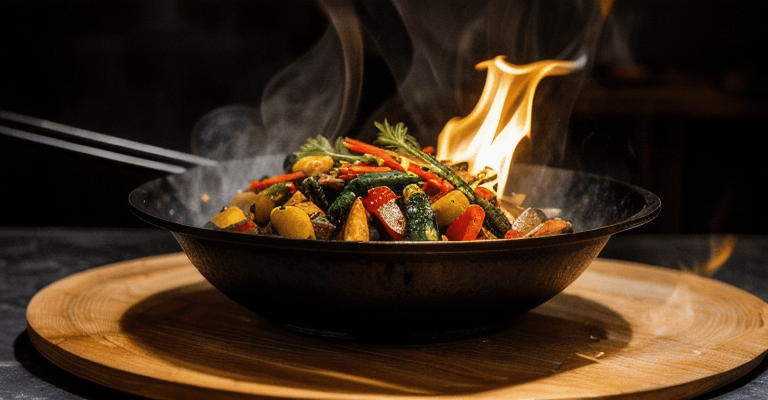
Stir-Fry Technique and Wok Hei — Thermal Mass, Leidenfrost, and High-Heat Chemistry
Wok hei science with thermal conductivity data, oil smoke points, BTU requirements, batch size limits, and a precise timing chart for stir-fry mise en place.
What Wok Hei Actually Is
What does this actually mean in practice, and when does it matter?
Wok hei — literally “breath of the wok” — is not a poetic abstraction. It is a specific flavor compound profile generated when food contacts a wok surface at 300°C or above in the presence of vaporized oil. The flavor results from three simultaneous reactions occurring in under 2 seconds of contact:
- Maillard reaction between amino acids and reducing sugars on the food surface (begins at 140°C, accelerates dramatically above 180°C)
- Caramelization of sugars at the wok surface (sucrose caramelizes at 160°C, glucose at 150°C)
- Fat pyrolysis — oil at the smoke point and beyond breaks down into short-chain aldehydes, lactones, and furanones that are the signature “charred but not burnt” aroma
The critical detail: these reactions produce roughly 800-1,000 volatile flavor compounds, but they degrade within 30-60 seconds of plating. This is why restaurant stir-fry tastes different from takeaway that sat in a container for 15 minutes. Wok hei is a volatile, ephemeral flavor that must be served immediately.
Wok Material Comparison
The wok material determines how quickly you reach wok hei temperatures and how well the wok maintains heat when cold food hits the surface.
| Property | Carbon Steel (1.5mm) | Carbon Steel (2.0mm) | Cast Iron | Stainless Steel (tri-ply) |
|---|---|---|---|---|
| Thermal conductivity | 51 W/m·K | 51 W/m·K | 52 W/m·K | 16 W/m·K (steel layer) |
| Weight (14” / 36cm wok) | 1.2 kg | 1.6 kg | 3.8 kg | 2.1 kg |
| Time to reach 300°C (gas burner, 12,000 BTU) | 2.5 min | 3.5 min | 8 min | 6 min |
| Max safe working temp | 450°C+ | 450°C+ | 400°C | 260°C (handle limits) |
| Temperature drop when 200g protein added | -85°C | -60°C | -35°C | -95°C |
| Recovery time to 300°C after protein addition | 18 sec | 14 sec | 8 sec | 35 sec |
| Seasoning | Required — polymerized oil layer | Required | Required | Not applicable |
| Reactivity with acid | High (unseasoned) | High (unseasoned) | High | None |
Cast iron holds the most heat (high thermal mass: 3.8 kg of iron at 300°C is a serious energy reservoir), but it is too heavy to toss. Carbon steel at 2.0mm is the professional compromise — sufficient thermal mass for heat retention with manageable weight for the constant motion stir-frying demands.
The temperature drop row is the most important data point. When 200g of room-temperature protein hits the wok, stainless steel loses 95°C and takes 35 seconds to recover — during which the food steams instead of searing. Cast iron loses only 35°C and recovers in 8 seconds. This is why material choice determines whether you get wok hei or steamed vegetables.
The Leidenfrost Effect — Your Temperature Gauge
The Leidenfrost effect occurs when water contacts a surface hot enough to instantly vaporize the contact layer, creating a cushion of steam that suspends the remaining droplet. This is your most reliable temperature test.
| Water Behavior | Surface Temperature | Meaning for Cooking |
|---|---|---|
| Spreads and evaporates slowly | Below 100°C | Far too cold — do not add oil |
| Sizzles and evaporates in 2-3 sec | 100-150°C | Too cold for stir-fry |
| Sizzles violently, evaporates in under 1 sec | 150-200°C | Adequate for sauteing, not for wok hei |
| Droplet dances and skitters across surface (Leidenfrost) | 200-250°C | Getting close — add oil now |
| Droplet fragments into tiny dancing beads | 250-300°C | Optimal — oil will shimmer immediately |
| Droplet explodes on contact | 350°C+ | Too hot — oil will instantly smoke, food will carbonize |
The procedure: flick 3-4 drops of water into the dry, heated wok. When the drops skitter and dance without immediately evaporating, you are at 200-250°C. Add oil immediately — it will reach smoke point in 5-10 seconds at this surface temperature, and you have a 15-second window to begin adding food.
Oil Smoke Points for Wok Cooking
Standard smoke point charts list refined oils tested in laboratory conditions. Actual smoke points in a wok are 5-15°C lower due to residual seasoning compounds and trace food particles. These are adjusted real-world values.
| Oil | Lab Smoke Point | Effective Wok Smoke Point | Flavor Contribution | Wok Hei Suitability |
|---|---|---|---|---|
| Refined peanut oil | 232°C | 220°C | Mild nutty, clean | Excellent — the traditional choice |
| Avocado oil (refined) | 271°C | 255°C | Neutral | Excellent — highest usable smoke point |
| Rice bran oil | 254°C | 240°C | Very mild, slightly sweet | Excellent — popular in Japanese/Korean wok cooking |
| Refined sunflower oil | 232°C | 218°C | Neutral | Good |
| Refined canola oil | 238°C | 222°C | Slightly fishy at pyrolysis | Acceptable — off-flavors possible above 260°C |
| Sesame oil (refined) | 210°C | 195°C | Strong nutty | Poor for primary oil — use as 10% blend or finishing |
| Extra virgin olive oil | 191°C | 175°C | Fruity, peppery | Do not use — smokes before wok hei temps |
| Unrefined coconut oil | 177°C | 165°C | Strong coconut | Do not use — smokes before wok hei temps |
Use 15-20ml (1 tablespoon) of oil for a 36cm wok. More oil does not help — it pools at the bottom rather than coating the cooking surface, and the pooled oil deep-fries rather than stir-fries. Tilt and swirl to coat the sloped sides within 3 seconds of adding oil.
Mise en Place Timing Chart
Stir-fry moves too fast for mid-cook preparation. Everything must be cut, measured, and arranged before the wok is heated. A complete stir-fry for two people takes 3-5 minutes of active cooking.
| Phase | Time (from oil addition) | Action | Wok Surface Temp | Technique |
|---|---|---|---|---|
| T+0 sec | Oil in | Swirl to coat sides | 250°C → 220°C (oil absorbs heat) | Tilt and rotate wok |
| T+5 sec | Protein in (200g max) | Spread in single layer, do not touch for 30 sec | 220°C → 160°C (thermal shock) | Press flat against surface |
| T+35 sec | First flip of protein | Sear second side | 160°C → 200°C (recovering) | Spatula flip, not toss |
| T+60 sec | Protein out to plate | Remove before fully cooked (carryover will finish it) | 200°C → 250°C (wok empty, reheating) | Speed matters — 5 sec max |
| T+75 sec | Aromatics in (garlic, ginger, scallion whites — 30g) | Stir constantly, 15 sec max or garlic burns | 250°C → 200°C | Rapid circular motion |
| T+90 sec | Dense vegetables in (150g — broccoli, carrots) | Toss every 5 sec | 200°C → 170°C | Wok toss or rapid spatula |
| T+150 sec | Leafy/tender vegetables (100g — snow peas, peppers) | Toss every 3 sec | 170°C → 155°C | Quick incorporation |
| T+180 sec | Sauce in (45-60ml premixed), protein returns | Sauce hits hot wok surface and reduces instantly | 155°C → boiling sauce | Pour down the side of the wok, not center |
| T+195 sec | Final toss and plate | 3-4 vigorous tosses to coat everything | Sauce thickening | Plate immediately |
The protein goes in and comes out first. This is non-negotiable. Leaving protein in the wok while cooking vegetables guarantees overcooking the protein and steaming the vegetables.
BTU Requirements — Home vs. Restaurant
The fundamental limitation of home stir-fry is thermal output. Professional wok burners deliver 10-20x more heat than home stoves.
| Heat Source | BTU Output | Time to Heat 36cm Wok to 300°C | Can Achieve Wok Hei? | Max Batch Size |
|---|---|---|---|---|
| Home electric coil | 6,000-7,500 BTU equivalent | Cannot reach 300°C | No | 150g total food |
| Home gas burner (standard) | 9,000-12,000 BTU | 3-4 minutes | Barely — with small batches | 200g total food |
| Home gas burner (power burner) | 18,000-22,000 BTU | 1.5-2 minutes | Yes — with discipline | 350g total food |
| Outdoor propane wok burner | 55,000-65,000 BTU | 45 seconds | Yes — restaurant quality | 500g total food |
| Restaurant jet wok burner | 100,000-150,000 BTU | 20 seconds | Yes — this is the standard | 800g total food |
The takeaway for home cooks: your stove is the bottleneck, not your technique. A 12,000 BTU home burner can produce acceptable stir-fry — but only if you work in small batches and never overload the wok.
Batch Size Limits — The Physics of Overloading
When cold food hits a hot wok, it absorbs thermal energy. If the food mass exceeds the wok’s thermal energy reserve, the surface temperature drops below 100°C and the food begins to steam in its own released moisture. This is the single most common stir-fry failure.
| Wok Size | Wok Surface Area | Max Food Load (home 12K BTU) | Max Food Load (restaurant 120K BTU) | Critical Density |
|---|---|---|---|---|
| 30cm (12”) | 707 cm² | 150g | 500g | 0.21 g/cm² home / 0.71 g/cm² restaurant |
| 36cm (14”) | 1,018 cm² | 200g | 700g | 0.20 g/cm² home / 0.69 g/cm² restaurant |
| 40cm (16”) | 1,257 cm² | 250g | 900g | 0.20 g/cm² home / 0.72 g/cm² restaurant |
The critical density on a home burner is approximately 0.20 g/cm² of wok cooking surface. Exceed this and you cross from stir-frying to steam-braising. For a standard 36cm home wok, that means 200g of total food — roughly one portion. To cook for four people, you must stir-fry in four separate batches.
This is not a suggestion. It is physics. A home burner cannot deliver enough energy to maintain stir-fry temperatures with more than 200g of food. Every restaurant cook knows this — they have 10x your BTU output and still cook in controlled portions.
Wok Seasoning and Maintenance
A well-seasoned wok has a polymerized oil layer approximately 10-20 micrometers thick. This layer is not just non-stick — it contributes to wok hei by providing a reservoir of carbon compounds that participate in the Maillard reaction at the contact surface.
| Seasoning Step | Temperature | Duration | Oil Used | Result |
|---|---|---|---|---|
| Initial strip (new wok) | Stovetop high heat | 10 min | None — burn off factory coating | Bare gray steel visible |
| First seasoning coat | 260°C (oven or stovetop) | 15 min per coat, 3 coats | Flaxseed oil, 5ml per coat | Dark brown, slightly tacky |
| Working seasoning (builds over use) | 200-300°C (normal cooking) | Ongoing | Cooking oil residue | Black, smooth, non-stick |
| Maintenance after cooking | Medium heat, 30 sec | Post-wash | 3ml oil, wipe with paper towel | Prevents rust, maintains layer |
Never use soap on a seasoned carbon steel wok. Hot water, a bamboo brush, and immediate drying over flame is the complete cleaning protocol. The seasoning layer is not dirt — it is a functional polymer coating built through repeated high-heat oil exposure, and it improves with every use.
If food sticks, the wok was not hot enough. If the wok smells rancid, the seasoning has degraded — strip it with steel wool and an oven’s self-clean cycle, then re-season from scratch.
Sauce Engineering for Stir-Fry
The sauce hits the wok last and must reduce in under 15 seconds. This means the sauce must be pre-mixed, pre-measured, and calibrated for instant thickening. Cornstarch is the thickener — it gelatinizes at 95°C, which happens immediately on a hot wok surface.
| Sauce Component | Amount per 2-Serving Wok-Load | Function |
|---|---|---|
| Soy sauce (light) | 1 tbsp (15ml) | Salt, umami, color |
| Shaoxing wine or dry sherry | 1 tbsp (15ml) | Aroma, deglazing, complexity |
| Oyster sauce | 1 tsp (5ml) | Body, sweetness, umami |
| Sesame oil | 1/2 tsp (2.5ml) | Aroma — added with sauce, not as cooking oil |
| Sugar | 1/2 tsp (2g) | Balances salt, promotes browning |
| White pepper | Pinch | Heat without chili |
| Cornstarch | 1 tsp (3g) dissolved in 2 tbsp (30ml) water | Instant thickening at wok temperature |
The slurry ratio: 1 teaspoon cornstarch per 2 tablespoons cold water. Stir immediately before adding to the wok — cornstarch settles within 30 seconds. Pour down the side of the wok (not the center — it cools the food) and toss vigorously 3–4 times. The sauce should glaze every surface within 10 seconds. If it pools at the bottom, you added too much liquid or the wok was too cool.
Common Stir-Fry Failures — Diagnosis Table
| Symptom | Cause | Fix |
|---|---|---|
| Vegetables release water and stew | Wok too cold or batch too large | Reduce batch to 200g; heat wok until water droplets dance |
| Protein sticks to wok | Surface not hot enough or seasoning degraded | Heat until smoking; re-season if needed |
| Everything tastes the same (steamed) | All ingredients added at once | Stage ingredients: protein → aromatics → dense veg → tender veg → sauce |
| Garlic burned and bitter | Added too early or wok too hot | Add garlic at T+75 sec, never before protein is removed; keep moving 15 sec max |
| Sauce is gloopy and thick | Too much cornstarch | Reduce to 1/2 tsp per serving; add water 1 tbsp at a time |
| No wok hei flavor | Insufficient BTU output or wok not preheated | Preheat 3+ min; use power burner or outdoor setup |
| Meat is tough and chewy | Overcooked — left in wok too long | Remove protein at T+60 sec, return only for final toss with sauce |
How to apply this
Use the recipe-scaler tool to adjust portions to scale ingredient quantities based on the data above.
Start with the reference tables above to identify the correct parameters for your specific ingredient or technique.
Measure your key variables (temperature, weight, time) before beginning — precision prevents waste.
Check the comparison tables to select the best approach for your situation and equipment.
Adjust quantities using the recipe-scaler when scaling up or down from the tested ratios.
Test with a small batch first, using the exact measurements from the tables before committing to full volume.
Verify your results against the expected outcomes listed in the quick reference section.
Honest Limitations
Home stir-fry will never taste exactly like restaurant stir-fry. A 12,000 BTU home burner delivers 8–12% of the thermal energy of a restaurant wok burner. You compensate with smaller batches and faster technique, but the wok hei intensity from a 150,000 BTU jet burner is physically impossible to replicate at home. Accept this and optimize within your constraints — a well-executed small-batch stir-fry on a home burner is still vastly better than a overloaded wok of steamed vegetables.
