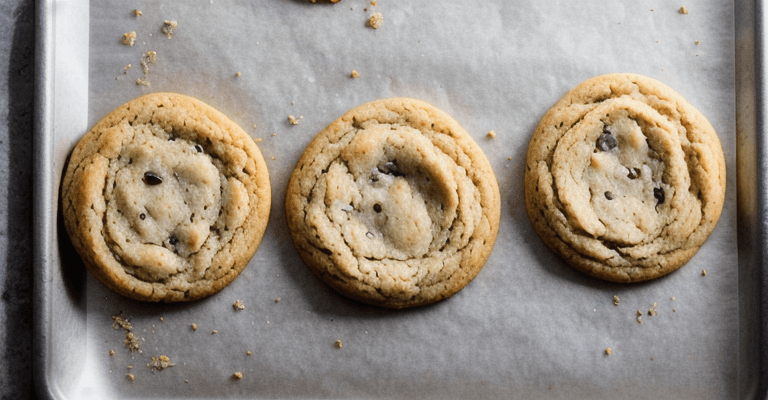
Why Cookies Spread Too Much — The Science of Spread, Set, and Rise (And How to Control Each)
Cookie spread is a race between butter melting, protein coagulation, and leavener activation. Here's the exact thermal timeline, every variable that affects spread, and the fix for each cause.
Why Do Your Cookies Spread Into Flat Discs Instead of Staying Thick and Chewy?
What variables — butter temperature, flour protein, sugar ratio, leavening timing — determine whether cookies spread thin or hold their shape? The difference between a flat crispy cookie and a thick chewy one is not luck or oven variation. It is chemistry: fat melting rate, gluten network formation, sugar dissolution, and gas cell timing. This guide maps each variable to its effect on spread, with the data tables to control the outcome deliberately.
The thermal timeline inside your cookie
Cookie baking is a race between three thermal events. The order they finish determines whether you get a thick, chewy cookie or a flat, crispy disc.
| Temperature | What Happens | Effect on Spread |
|---|---|---|
| 32–35°C (90–95°F) | Butter melts | Dough loses structural support, spreads outward under gravity |
| 50–60°C (122–140°F) | Sugar dissolves further into liquid phase | More liquid = more flow |
| 62–70°C (144–158°F) | Egg proteins begin to coagulate | Edges start to set, spread slows |
| 80–90°C (176–194°F) | Baking soda/powder releases CO2 | Cookie puffs upward (rise) |
| 100°C (212°F) | Water evaporates from surface | Crust forms, sets final shape |
| 140–165°C (284–329°F) | Maillard reaction + caramelization | Browning, flavor development |
The critical finding: If butter melting (32°C) finishes before protein coagulation begins (62°C), the cookie has already spread flat. Every fix for excess spread is about closing this 30-degree gap — either delaying butter melt or accelerating protein set.
The 7 variables that control spread
1. Butter temperature (most impactful)
Creaming room-temperature butter (18–20°C) is correct for trapping air bubbles. But if butter is soft (above 22°C) or melted, the dough enters the oven with no solid fat to resist gravity.
Fix: Chill formed dough balls for 30–60 minutes before baking. Cold dough (4°C) buys 3–5 minutes of oven time before butter reaches its melting point. This is enough for egg proteins to begin setting.
| Dough Temperature at Oven Entry | Expected Spread | Cookie Style |
|---|---|---|
| 4°C (refrigerated 1 hour) | Minimal — thick, domed | New York-style, bakery thick |
| 10°C (refrigerated 30 min) | Moderate — even | Standard chewy |
| 18°C (room temp) | Normal — slight spread | Classic home-baked |
| 24°C (warm kitchen) | Excessive — flat | Needs chilling |
| 32°C (melted butter used) | Maximum — very flat, thin | Intentional thin & crispy only |
2. Flour-to-fat ratio
Too little flour means too little gluten network to hold the dough together as fat melts. The flour absorbs liquid, and gluten strands create a web that resists flow.
Fix: Add 15–30g (1–2 tablespoons) more flour per batch. Weigh flour — cups are unreliable. Depending on how you scoop, 1 cup of flour can weigh anywhere from 115g to 150g.
3. Oven temperature
A cool oven lets the cookie spread slowly because the surface takes longer to reach protein coagulation temperature. In a properly hot oven (190°C / 375°F actual), the surface sets within 4–5 minutes.
Fix: Use an oven thermometer. Consumer ovens are off by 10–30°C. Bake at 190°C actual temperature, not dial setting.
4. Sugar type and amount
Sugar is hygroscopic — it pulls water from flour and eggs, creating a liquid phase that flows. More sugar = more liquid = more spread.
| Sugar Type | Moisture Content | Acidity | Spread Effect | Cookie Texture |
|---|---|---|---|---|
| White granulated | 0% | Neutral | Baseline spread | Crispy edges, snappy |
| Brown sugar (light) | 3.5% moisture | Slightly acidic (pH ~5.5) | +15% more spread | Chewy, moist |
| Brown sugar (dark) | 6.5% moisture | More acidic (pH ~5.0) | +25% more spread | Very chewy, toffee notes |
| Powdered sugar | 0% + 3% cornstarch | Neutral | -15% less spread | Tender, sandy (shortbread-like) |
| Honey / maple syrup | 17–20% water | Varies | +30% more spread | Soft, sticky, caramelized |
Fix: Reduce sugar by 10–15%. Switch from brown to white for less spread. The molasses in brown sugar adds both moisture and acidity, both of which increase spread.
5. Egg ratio and egg temperature
Eggs are the primary structure-builder. More egg = more protein = faster set = less spread. Egg whites set at 62°C; egg yolks set at 70°C.
Fix: For less spread, add an extra egg yolk. The yolk’s lecithin acts as an emulsifier (binding fat and water) while its proteins provide earlier coagulation. Do not add extra whites alone — they add water without enough early-setting protein.
6. Baking sheet properties
| Sheet Type | Heat Absorption | Bottom Browning | Effect on Spread |
|---|---|---|---|
| Light aluminum, uncoated | Low | Moderate, even | Least spread (gold standard) |
| Dark nonstick | High | Fast, can burn | Edges set early, center spreads unevenly |
| Insulated / air-cushion | Very low | Slow | More spread (bottom stays cool too long) |
| Parchment-lined aluminum | Low-moderate | Even | Slight increase vs bare aluminum |
| Silicone mat on aluminum | Low | Slow | More spread (insulation effect) |
Fix: Light-colored aluminum sheets without insulation produce the most consistent results. If using parchment, increase oven temp by 5°C to compensate.
7. Leavener type
Baking soda (sodium bicarbonate) needs an acid to react. Baking powder contains its own acid. Both produce CO2 for lift, but they behave differently with spread.
Fix: Baking soda promotes spread slightly more than baking powder because it raises pH, which weakens gluten and allows proteins to set at a higher temperature (more time to spread). Baking powder’s acid counterbalances this. For less spread: use baking powder, or reduce baking soda by ¼ teaspoon.
The diagnostic cheat sheet
| Symptom | Most Likely Cause | Fastest Fix | Underlying Physics |
|---|---|---|---|
| Flat, thin, uniform | Warm butter at oven entry | Chill dough 30–60 min | Fat melts before proteins set |
| Spread + raw center | Oven too cool | Verify with thermometer, bake at 190°C actual | Surface can’t reach set temp fast enough |
| Spread + crispy edges | Too much sugar | Reduce sugar 10% | Excess dissolved sugar = excess liquid phase |
| Spread + greasy texture | Too much butter | Weigh ingredients (don’t use cups) | Fat exceeds flour’s absorption capacity |
| One side spreads more | Uneven oven heat | Rotate sheet 180° at halfway | Hotter side sets first, cooler side keeps flowing |
| Spread + puffy then deflate | Too much leavener | Reduce baking soda by ¼ tsp | Over-risen structure collapses as CO2 escapes |
| Cracks on top + minimal spread | Too much flour | Reduce flour by 15g | Excessive gluten network resists all flow |
The intentional spread spectrum
Not all spread is bad. Cookie style is a deliberate choice along the spread-set-rise spectrum:
| Cookie Style | Desired Spread | Key Technique |
|---|---|---|
| Thin & crispy (Tate’s style) | Maximum | Melted butter, more sugar, less flour, no chill |
| Chewy & flat (classic Toll House) | Moderate-high | Room temp butter, brown sugar dominant |
| Thick & chewy (bakery style) | Minimal | Cold butter, extra yolk, chill 24 hours, more flour |
| Cakey & domed (soft batch) | Minimal + high rise | Creamed butter, more egg, more baking powder |
| Crinkle / crackle top | Moderate | High sugar ratio, powdered sugar coat, short chill |
The 24-hour chill thesis: Aging cookie dough in the refrigerator for 24–72 hours does more than just control spread. During this rest, flour fully hydrates, enzymes break down starches into sugars (more browning), and flavors develop. This is why bakery cookies taste better — it’s not a secret ingredient, it’s time.
Quick Reference Summary
| Variable | More spread | Less spread |
|---|---|---|
| Butter temperature | Warm/melted (fast melt) | Cold/solid (slow melt) |
| Sugar type | White/granulated (dissolves fast) | Brown/molasses (holds moisture) |
| Flour protein | Low (cake flour, less gluten) | High (bread flour, more structure) |
| Leavening | Baking powder (early rise) | Baking soda (delayed rise) |
| Egg content | More yolk (fat, spread) | More white (protein, structure) |
| Chill time | None (fat melts immediately) | 24-72 hours (fat solidifies) |
Decision rule: For thick chewy cookies: cold butter, bread flour, brown sugar, baking soda, chill 24h. For thin crispy cookies: melted butter, AP flour, white sugar, baking powder, no chill.
How to apply this
Use the recipe-scaler tool to adjust portions to scale ingredient quantities based on the data above.
Start with the reference tables above to identify the correct parameters for your specific ingredient or technique.
Measure your key variables (temperature, weight, time) before beginning — precision prevents waste.
Check the comparison tables to select the best approach for your situation and equipment.
Adjust quantities using the recipe-scaler when scaling up or down from the tested ratios.
Test with a small batch first, using the exact measurements from the tables before committing to full volume.
Verify your results against the expected outcomes listed in the quick reference section.
Honest Limitations
Cookie spread is affected by variables beyond ingredient ratios — oven calibration, baking sheet material (dark vs. light), altitude, and ambient humidity all influence outcomes. The spread recommendations assume a conventional home oven at sea level. Gluten-free flour substitutions change the structural dynamics entirely and are not covered here. Specific brand differences in butter water content (European vs. American) affect melt behavior. This guide covers drop cookies; rolled, piped, and bar cookies have different spread mechanics.
