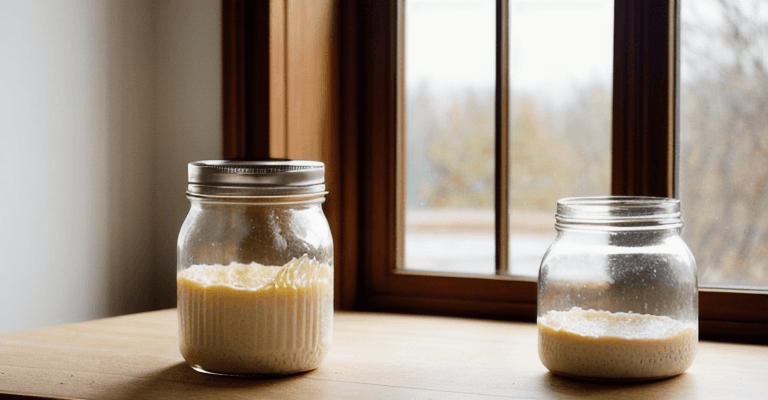
Sourdough Starter From Scratch — The Microbiology Day by Day
Create a sourdough starter in 7-14 days with flour and water. Day-by-day microbial succession timeline, feeding ratios by maintenance style, flour comparison data, troubleshooting matrix, and the science of why Day 4-5 fools everyone.
What Do You Actually Need to Know About Sourdough Starter From Scratch?
What are the common mistakes, the precise measurements, and the science-backed techniques that separate reliable results from guesswork? This guide provides the reference tables, ratio calculations, and decision frameworks for sourdough starter from scratch — organized for quick lookup and practical application.
What a sourdough starter actually is — the microbiology
A sourdough starter is a stable symbiotic colony of wild yeast (Saccharomyces cerevisiae, Kazachstania exigua, Candida humilis) and lactic acid bacteria (LAB — primarily Lactobacillus sanfranciscensis, L. plantarum, L. brevis). The yeast produces CO2 (leavening) and ethanol. The bacteria produce lactic and acetic acids (flavor, preservation, and dough conditioning).
You don’t add yeast — it’s already on the flour, on your hands, in your kitchen air. You’re creating a selective environment where the right organisms outcompete the wrong ones. The pH drop from bacterial acid production is the selection mechanism: beneficial LAB and wild yeast tolerate pH 3.5-4.5, while most spoilage organisms cannot.
The key ratio in a mature starter: Roughly 100:1 bacteria to yeast cells. The bacteria dominate by cell count, but the yeast dominate gas production. This ratio self-regulates — LAB produce acids that suppress competing organisms while leaving yeast unaffected.
What you need
- Unbleached flour (whole wheat or rye for days 1-3, then all-purpose if desired)
- Water (room temperature, unchlorinated — let tap water sit 30 minutes or use filtered)
- A glass jar (500ml minimum, straight-sided for easy rise tracking)
- A kitchen scale (volume measurements are too imprecise)
- A rubber band (mark the level after each feeding to track rise)
Flour comparison — why the starting flour matters
| Flour Type | Wild Yeast Population | Nutrient Density | Kickstart Speed | Flavor Profile | Best Use |
|---|---|---|---|---|---|
| Whole wheat | High — bran carries diverse microbes | High — minerals, vitamins | Fastest (Day 5-7) | Nutty, wheaty | Days 1-3 kickstart |
| Dark rye | Very high — highest microbial diversity | Very high | Fastest (Day 4-6) | Strong, tangy | Days 1-3 kickstart (best option) |
| All-purpose (unbleached) | Moderate | Moderate | Slower (Day 7-10) | Mild, clean | Ongoing maintenance |
| Bread flour | Moderate | Moderate + higher protein | Slower (Day 7-10) | Mild | Maintenance if you want stiffer starter |
| Bleached all-purpose | Low — chlorine kills surface microbes | Low — nutrients stripped | Very slow (Day 10-14+) | Bland | Avoid for starting |
| Whole spelt | High | High | Fast (Day 5-7) | Sweet, nutty | Alternative to wheat for sensitive bakers |
Key finding: Bleached flour can take twice as long to develop an active starter. The chlorine gas used in bleaching kills surface microorganisms. If your starter shows no activity by Day 5, check if your flour is bleached — it’s the most common silent failure.
Day-by-day schedule with microbial succession
Day 1
Mix 50g whole wheat flour + 50g water in the jar. Stir vigorously (introduces air and disperses microbes). Cover loosely. Leave at room temperature (21-24C ideal).
What to expect: Nothing visible. Microbially: diverse population of bacteria and yeasts from the flour are beginning to hydrate and metabolize. The pH is approximately 6.0-6.5 (near neutral).
Day 2
You may see small bubbles. You may not. Both are normal. Do not feed. The initial microbial population needs time to establish without competition from fresh flour.
Microbial state: Enterobacteriaceae and Leuconostoc species are the first colonizers. They produce gas (CO2) and can create a false sense of activity. pH begins dropping toward 5.0-5.5.
Day 3
Discard all but 50g of the starter. Add 50g whole wheat flour + 50g water. Stir. Cover.
What to expect: Bubbles appearing, possibly a sour or unpleasant smell (acetone, cheese, vomit). This is the Leuconostoc bloom — they produce diacetyl and other off-flavor compounds. pH: 4.5-5.0. This is normal and temporary.
Day 4 — the trap day
Discard to 50g. Feed 50g flour + 50g water. You can switch to all-purpose from now on.
What to expect: Possibly dramatic activity — the starter doubles or triples. This is NOT readiness. This is the Leuconostoc peak. These bacteria produce CO2 but cannot leaven bread. Their population will crash within 24-48 hours as pH drops further.
The Day 4 trap data:
| Metric | Day 4 (“False Ready”) | Day 7-10 (Actually Ready) |
|---|---|---|
| Volume rise | 2-3x (dramatic) | 2x (consistent, predictable) |
| Rise time | 2-4 hours | 4-8 hours |
| Dominant organisms | Leuconostoc, Enterobacteriaceae | Lactobacillus, Saccharomyces |
| pH | 4.5-5.0 | 3.5-4.2 |
| Smell | Sharp, unpleasant, cheesy | Pleasantly sour, yeasty, fruity |
| Bread result | Dense, gummy, off-flavored | Open crumb, tangy, well-risen |
Day 5 — the silence that scares beginners
Discard to 50g. Feed 50g flour + 50g water.
What to expect: Activity slows dramatically or stops. The Leuconostoc population crashes as pH drops below 4.5 — they cannot survive at this acidity. Acid-tolerant Lactobacillus species are establishing dominance but aren’t yet producing enough CO2 through their yeast partners. pH: 4.0-4.5.
Do not give up. This quiet period lasts 1-3 days and is the critical transition to a stable culture.
Day 6
Discard to 50g. Feed 50g flour + 50g water.
What to expect: Bubbles return — smaller but more consistent than the Day 4 bloom. A pleasantly sour, yeasty smell develops. pH: 3.8-4.2. Lactobacillus sanfranciscensis is establishing dominance.
Day 7+
Discard to 50g. Feed 50g flour + 50g water. The starter should roughly double in volume within 4-8 hours of feeding.
The float test: Drop a small spoonful into water. If it floats, the starter has enough trapped CO2 to leaven bread. If it sinks, continue daily feeding for 2-5 more days. Some starters take 10-14 days. Patience is non-negotiable.
Temperature impact on fermentation timeline
| Ambient Temperature | Days to Active Starter | Flavor Profile | Rise Speed (Mature) | Acid Balance |
|---|---|---|---|---|
| 18-20C (64-68F) | 10-14 days | More acetic (vinegary tang) | 8-12 hours | Acetic-dominant |
| 21-24C (70-75F) | 7-10 days (ideal) | Balanced lactic/acetic | 6-8 hours | Balanced |
| 25-27C (77-80F) | 5-7 days | More lactic (yogurty, mild) | 4-6 hours | Lactic-dominant |
| 28-30C (82-86F) | 4-6 days | Strongly lactic, mild | 3-5 hours | Heavily lactic |
| Above 30C (86F+) | Unpredictable | Risk of off-flavors | Too fast — overferments | Imbalanced |
The temperature-flavor connection: Acetic acid (vinegary tang) is produced more at cooler temperatures and with stiffer (lower hydration) starters. Lactic acid (mild, yogurty sourness) is produced more at warmer temperatures and with wetter starters. Professional bakers manipulate temperature and hydration to control flavor — the same culture produces very different bread depending on conditions.
Ongoing maintenance — feeding ratios compared
| Maintenance Style | Feeding Ratio (S:F:W) | Feeding Frequency | Peak Time | Best For | Discard Volume |
|---|---|---|---|---|---|
| Room temp, daily baking | 1:1:1 (50g:50g:50g) | Every 24 hours | 4-8 hours | Daily bread bakers | 50g per feed |
| Room temp, aggressive | 1:2:2 (25g:50g:50g) | Every 12-16 hours | 6-10 hours | Peak activity, reduced sourness | 75g per feed |
| Room temp, stiff | 1:2:1 (50g:100g:50g) | Every 24 hours | 8-12 hours | More acetic flavor, slower pace | Minimal |
| Refrigerator, weekly | 1:5:5 (20g:100g:100g) | Once per week | Pull + feed + 4-6h to peak | Weekend bakers | 20g per week |
| Refrigerator, biweekly | 1:10:10 (10g:100g:100g) | Every 2 weeks | Pull + 2 feeds over 24h | Occasional bakers | Minimal |
| Dried backup | Spread thin, dehydrate | Reconstitute as needed | 3-5 days to reactivate | Insurance / sharing | None |
Discard math: A 1:1:1 feeding starting at 50g produces 50g of discard daily = 350g per week. That’s 1.4kg per month of starter discard. Use it: pancakes, waffles, crackers, pizza dough, flatbread, banana bread. Discard is active culture past its peak — it won’t leaven bread alone but has flavor and some lift.
Troubleshooting matrix
| Symptom | Most Likely Cause | Fix | Timeline to Recovery |
|---|---|---|---|
| No bubbles by Day 4 | Too cold (<20C) | Move to 24-27C (top of fridge, oven with light on) | 2-3 days |
| No bubbles by Day 7 | Bleached flour or chlorinated water | Switch to unbleached flour + filtered water | Restart recommended |
| Pink or orange streak | Mold or harmful bacteria contamination | Discard entirely and start over | Non-negotiable — no recovery |
| Gray or black surface | Normal oxidation | Stir in — harmless | Immediate |
| Hooch (dark liquid on top) | Hungry — needs feeding | Pour off liquid, feed immediately | 1-2 feeds |
| Doubles then collapses before use | Peaked and over-fermented | Feed more frequently or use immediately at peak | Switch to 12h feeding cycle |
| Smells like nail polish remover | Acetone from acetic acid overproduction | Feed more frequently, add pinch of whole wheat | 2-3 feeds |
| Smells like vomit (butyric acid) | Wrong bacteria dominating, often too warm | Reduce temp to 21-24C, discard more aggressively (keep only 20g) | 3-5 days |
| Rises beautifully but bread doesn’t rise | Starter is too young — LAB active but yeast underdeveloped | Continue feeding 5-7 more days | 5-7 days |
| Mold on surface (fuzzy, white/green/black) | Contamination — often from unclean jar or utensils | Discard and restart with clean equipment | Start over |
The honest timeline
Most sourdough guides say “7 days to a starter.” The reality: 7 days gets you an active culture. It takes 2-4 weeks of consistent feeding before the microbial ecology fully stabilizes and produces reliable, predictable leavening. Professional bakeries condition new starters for 4-6 weeks before relying on them for production.
The fermentation microbiology is well-documented: microbial succession in sourdough follows a predictable pattern of colonization, competition, and stabilization. The flour you start with determines the initial diversity of organisms — grain storage conditions and contaminant profiles vary by supplier, which is why two people following the same recipe can get different results.
Your starter is a living ecosystem. Treat it like one — stable environment, consistent feeding, patience through the awkward middle phase. The bread will come.
Quick Reference Summary
| Stage | Timeline | Feeding ratio | Signs of progress |
|---|---|---|---|
| Day 1-2 | Mixing | 1:1:1 (starter:flour:water by weight) | Bubbles may appear (often false start — leuconostoc, not yeast) |
| Day 3-5 | Stalling | 1:1:1 daily | Activity may slow or smell bad — this is normal |
| Day 6-10 | Establishing | 1:2:2 or 1:3:3 | Consistent rise and fall; less sour smell |
| Day 10-14 | Maturing | 1:5:5 | Doubles in 4-8 hours; fruity/yeasty smell |
| Ongoing | Maintenance | 1:5:5 to 1:10:10 | Predictable doubling time; float test passes |
Decision rule: A starter is ready when it reliably doubles in 4-8 hours after feeding and passes the float test (a spoonful floats in water). Date labels and calendar days are less reliable than observing actual behavior.
How to apply this
Use the recipe-scaler tool to adjust portions to scale ingredient quantities based on the data above.
Start with the reference tables above to identify the correct parameters for your specific ingredient or technique.
Measure your key variables (temperature, weight, time) before beginning — precision prevents waste.
Check the comparison tables to select the best approach for your situation and equipment.
Adjust quantities using the recipe-scaler when scaling up or down from the tested ratios.
Test with a small batch first, using the exact measurements from the tables before committing to full volume.
Verify your results against the expected outcomes listed in the quick reference section.
Honest Limitations
Starter timelines vary enormously — climate (warm = faster), flour type (whole grain = faster than white), water quality (chlorinated water can inhibit), and ambient microbiome all affect development speed. The “day 2 activity” is almost always leuconostoc bacteria, not yeast — it produces CO₂ but dies off as acidity increases. Some starters take 3-4 weeks to become reliable. Flour type affects flavor: rye produces more sour starters; white bread flour produces milder ones. This guide covers creating a new starter; reviving a dried or neglected starter follows a different (faster) protocol. Commercial sourdough starters provide consistency but reduce the “wild” character.
