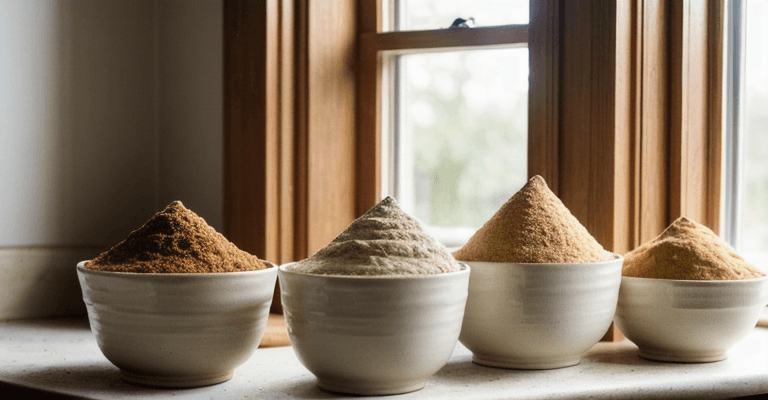
Flour Protein Content — Why It Matters and Which Flour for Which Job
Protein percentages for every common flour type, how protein creates gluten structure, hydration differences, and exact substitution ratios for swapping between flours.
What flour protein actually does
Wheat flour protein is primarily glutenin and gliadin. When hydrated and agitated (mixed, kneaded, folded), these proteins bond into an elastic network called gluten. This network traps gas from yeast or chemical leaveners, giving baked goods their structure.
Higher protein flour produces stronger, more elastic gluten. This is desirable in bread, where the dough must stretch to hold large gas bubbles. It is undesirable in cake, where you want a tender, crumbly texture with minimal chew. Choosing the correct flour protein level is the single most impactful ingredient decision in baking.
Protein content is measured as a percentage of flour weight. The range spans from about 5% (some Asian cake flours) to 14–16% (high-gluten bread flours). Every point of protein percentage changes the behavior of the dough or batter meaningfully.
Flour types by protein content
| Flour type | Protein % | Gluten strength | Best uses |
|---|---|---|---|
| Cake flour | 5–8% | Very weak | Layer cakes, angel food, tender muffins, biscuits |
| Pastry flour | 8–9% | Weak | Pie crusts, tart shells, scones, cookies |
| Italian 00 flour | 8–12.5% | Variable (depends on grade) | Pizza (higher), pasta (lower), focaccia |
| All-purpose (US, national brands) | 10–11.5% | Moderate | General baking, cookies, quick breads, pancakes |
| All-purpose (Southern US brands, e.g., White Lily) | 8–9% | Weak-moderate | Biscuits, Southern-style cornbread |
| All-purpose (Canadian) | 11.5–12.5% | Moderate-strong | Closer to US bread flour |
| Bread flour | 12–13% | Strong | Sandwich bread, rolls, pizza, bagels |
| High-gluten flour | 13–14.5% | Very strong | Bagels, pretzels, high-hydration artisan bread |
| First clear flour | 14–16% | Very strong, slightly coarse | Rye bread blends, hearty loaves |
| Whole wheat flour | 13–14% | Strong but disrupted by bran | 100% whole wheat bread, blended loaves |
| Semolina (durum) | 12–13% | Strong, inelastic | Dried pasta, couscous, some breads |
| Rye flour (light) | 8–9% | Negligible (no gluten-forming proteins) | Rye bread with wheat blend, crackers |
| Rye flour (dark/whole) | 10–12% | Negligible | Pumpernickel, heavy rye breads |
A critical note on regional variation: US all-purpose flour (Gold Medal, Pillsbury) averages 10.5% protein. Southern brands like White Lily mill from softer wheat at 8–9%. Canadian all-purpose (Robin Hood, Five Roses) runs 11.5–12.5% because Canadian wheat varieties are inherently higher in protein. A recipe that works perfectly with King Arthur all-purpose (11.7%) may produce tough results with Canadian AP and slack results with White Lily.
Hydration differences by protein level
Higher-protein flour absorbs more water. This directly affects recipe scaling and substitution.
| Flour type | Approximate absorption | Water per 500g flour (bread) | Water per 500g flour (cake/quick bread) |
|---|---|---|---|
| Cake flour (7%) | 50–55% | — | 250–275ml |
| Pastry flour (9%) | 55–58% | — | 275–290ml |
| All-purpose (10.5%) | 58–62% | 290–310ml | 290–310ml |
| Bread flour (12.5%) | 62–67% | 310–335ml | — |
| High-gluten (14%) | 65–70% | 325–350ml | — |
| Whole wheat (13.5%) | 68–75% | 340–375ml | — |
Whole wheat flour absorbs significantly more water than its protein percentage alone would predict. The bran particles act like tiny sponges, absorbing water that would otherwise hydrate gluten. This is why 100% whole wheat recipes require 10–15% more liquid than white flour recipes at the same protein level. It is also why whole wheat dough benefits from an autolyse (resting flour and water together for 20–60 minutes before adding salt and yeast) — the bran needs time to fully hydrate.
Substitution ratios and techniques
When substituting between flour types, you must adjust both quantity and liquid.
| Substitution | Ratio by weight | Liquid adjustment |
|---|---|---|
| Bread flour for AP | 1:1 | Add 1–2 tbsp liquid per 500g flour |
| AP for bread flour | 1:1 | Reduce liquid by 1–2 tbsp per 500g |
| Cake flour for AP | 1:1 by weight | Reduce liquid by 1–2 tbsp per 500g |
| AP for cake flour | 1:1 by weight minus 2 tbsp cornstarch per 130g | Keep liquid same |
| Whole wheat for AP | Start with 50% WW, 50% AP | Add 2–4 tbsp liquid per 500g |
| 100% whole wheat for AP | 1:1 by weight | Add 15% more liquid, rest 30+ min |
| 00 flour for AP (pizza) | 1:1 | Reduce liquid by 1 tbsp per 500g |
| Southern AP for national AP | 1:1 | Reduce liquid by 1–2 tbsp per 500g |
The DIY cake flour method: For every 130g (1 cup) of all-purpose flour, remove 2 tablespoons (16g) of flour and replace with 2 tablespoons (16g) of cornstarch. Sift together three times. This dilutes the protein content from ~10.5% to approximately 8%, mimicking cake flour. It does not replicate the finer milling or chlorination of commercial cake flour, but it works in most layer cake recipes.
The vital wheat gluten method: To increase protein in AP flour to bread flour levels, add 1 tablespoon (8g) of vital wheat gluten per 130g of all-purpose flour. This raises protein from approximately 10.5% to 12.5%. Add an additional tablespoon of water per tablespoon of gluten added, since the gluten will absorb it.
Matching flour to technique
High-rise sandwich bread: Bread flour (12–13%). The strong gluten network supports tall rise and maintains structure after slicing. AP flour will produce a loaf that rises adequately but compresses more when sliced.
Thin-crust pizza: Italian 00 flour or bread flour. Both provide enough elasticity to stretch thin without tearing. The choice between them is about texture — 00 produces a crispier, more blistered crust in very hot ovens (above 400 °C / 750 °F). Bread flour produces a chewier, more structured crust better suited to home ovens (250 °C / 500 °F).
Flaky pie crust: Pastry flour or a 50/50 blend of AP and cake flour. You want just enough gluten to hold the dough together but not enough to make it elastic or tough. Overworking pie dough with bread flour is the fastest path to a tough, shrinking crust.
Tender layer cake: Cake flour. The low protein minimizes gluten formation even with the vigorous mixing that creaming butter and sugar requires. If your cakes are consistently dense or tough, switching from AP to cake flour will make a larger difference than any technique adjustment.
Cookies: AP flour for most recipes. The moderate protein provides enough structure to hold shape while remaining tender. For chewier cookies, swap to bread flour. For sandier, more delicate cookies (shortbread), swap to pastry flour or the DIY cake flour blend.
Brand protein content reference
Published protein percentages vary by source. These values are compiled from manufacturer nutritional labels and third-party testing as of 2025. Protein content can vary by 0.5% between production runs due to wheat crop variability.
| Brand | Country | Type | Protein % | Notes |
|---|---|---|---|---|
| King Arthur | US | All-purpose | 11.7% | Highest-protein national AP. Behaves closer to bread flour in delicate recipes |
| Gold Medal | US | All-purpose | 10.5% | Standard US baseline. Most American recipes assume this protein level |
| Pillsbury | US | All-purpose | 10.0–10.5% | Very similar to Gold Medal. Interchangeable in practice |
| White Lily | US (Southern) | All-purpose | 8.0–9.0% | Milled from soft red winter wheat. Essential for Southern biscuits and cornbread |
| Robin Hood | Canada | All-purpose | 12.0–12.5% | Canadian AP is effectively US bread flour. Adjust recipes accordingly |
| Caputo Tipo 00 (Blue, Pizzeria) | Italy | 00 pizza flour | 12.5% | High protein for 00 — designed for long-ferment pizza dough at 450+ °C |
| Caputo Tipo 00 (Red, Chef’s) | Italy | 00 general purpose | 11.0% | Lower protein — suited for pasta, pastry, and short-ferment applications |
| Bob’s Red Mill | US | Whole wheat | 14.0% | Stone-ground, coarser bran particles. Requires longer autolyse (30–60 min) |
| Shipton Mill No. 4 | UK | Strong bread flour | 13.0% | UK bread flour standard. Performs comparably to US King Arthur bread flour (12.7%) |
| Five Roses | Canada | All-purpose | 12.0% | Similar profile to Robin Hood. Canadian AP runs 1.5–2% higher than US AP |
The practical takeaway: if you follow a US recipe using King Arthur AP (11.7%) but substitute Robin Hood Canadian AP (12.5%), your dough will be tighter and less extensible. Reduce hydration by 1–2 tablespoons per 500g, or expect a chewier result. Going the other direction — White Lily (8.5%) in a recipe designed for King Arthur — produces slacker, more tender results. This is why “all-purpose” does not mean “universal.”
Gluten development timeline by flour
Different flours develop gluten at different rates. These timelines assume hand kneading at moderate pace or stand mixer at speed 2 (KitchenAid equivalent). “Basic development” means the dough is smooth and holds together. “Windowpane” means a small piece stretches thin enough to see light through without tearing.
| Flour type | Time to basic development | Time to windowpane | Kneading method | Overwork risk |
|---|---|---|---|---|
| Cake flour (7%) | 2–3 minutes | Not achievable — insufficient gluten-forming protein | Gentle fold only, never knead | High — toughens rapidly with any mechanical work |
| All-purpose (10.5%) | 5–7 minutes | 10–14 minutes by hand, 7–10 min by mixer | Hand knead or mixer speed 2 | Moderate — overworking produces tough, elastic crumb in cakes |
| Bread flour (12.5%) | 6–8 minutes | 12–18 minutes by hand, 8–12 min by mixer | Mixer speed 2 or vigorous hand knead | Low — bread flour is designed for extended kneading |
| High-gluten (14%) | 8–10 minutes | 15–22 minutes by hand, 10–15 min by mixer | Mixer speed 2–3, or stretch-and-fold over 2 hours | Very low — these flours tolerate aggressive mixing |
| Whole wheat (13.5%) | 8–12 minutes | 18–25 minutes by hand (bran interferes), 12–18 min by mixer | Autolyse 30–60 min first, then knead. Stretch-and-fold preferred | Low for kneading, but bran cuts gluten strands over time — don’t over-ferment |
Key insight: whole wheat flour has high protein (13.5%) but develops gluten slower and loses it faster than white bread flour at 12.5%. The bran particles physically cut gluten strands during mixing and fermentation. This is why 100% whole wheat bread benefits from shorter bulk fermentation (3–4 hours vs. 5–6 for white) and why autolyse is not optional for whole grain doughs — the bran needs time to soften before it does maximum damage to the gluten network.
What protein percentage doesn’t capture
Protein percentage is the most commonly cited flour specification, but it tells an incomplete story. Treating it as the sole variable leads to confusion when flours with identical protein numbers perform differently.
Protein quality varies by wheat variety. Hard red spring wheat (grown in North Dakota, Montana, Saskatchewan) produces flour with a high glutenin-to-gliadin ratio — strong, elastic gluten ideal for bread. Hard red winter wheat (Kansas, Oklahoma) has similar total protein but a lower glutenin ratio — the gluten is less elastic, more extensible. Two flours both labeled “12.5% protein” from different wheat classes will produce different bread. This is why King Arthur bread flour (primarily hard red spring) and some store-brand bread flours (hard red winter blends) feel different at the same hydration.
Ash content affects flavor and fermentation. Ash is the mineral content remaining after burning flour — a proxy for how much of the outer grain layers are included. French flour types are classified by ash (T55, T65, T80) rather than protein. Higher ash means more minerals, which feed yeast more actively, produce more complex flavor, and darken the crumb slightly. Two flours at 11% protein with different ash contents (0.55% vs. 0.75%) will ferment at different rates and taste different. US flour labeling does not require ash content disclosure.
Damaged starch changes water absorption unpredictably. Milling physically damages some starch granules. Damaged starch absorbs 2–4 times more water than intact starch but breaks down faster during fermentation, releasing that water and making the dough slackier over time. Industrial roller-milled flour has 5–8% damaged starch; stone-ground flour has 3–5%. This is one reason stone-ground flour often produces a drier-feeling dough at the same hydration — less damaged starch absorbing less water initially.
Freshness degrades protein functionality. Flour protein oxidizes slowly after milling. Fresh-milled flour (within 2 weeks) produces extensible, sticky doughs. Flour aged 4–8 weeks has oxidized protein that forms stronger, tighter gluten networks — this is why commercial bakeries prefer flour aged 3–6 weeks. Flour older than 6 months has measurably weaker gluten performance, even though the protein percentage on the label hasn’t changed. The protein is still there; its functional capacity has declined.
Home measurement is effectively impossible. You cannot measure flour protein content at home with any practical method. The Kjeldahl nitrogen analysis used by labs requires sulfuric acid digestion, distillation, and titration. Near-infrared spectroscopy (NIR) instruments cost $15,000–50,000. Trust the brand specification on the bag, buy from brands that publish protein percentages, and accept that batch-to-batch variation of 0.3–0.5% is normal and unavoidable.
Flour storage and shelf life
Protein functionality degrades over time, and improper storage accelerates the process. Rancidity from oxidized fats in whole grain flours is a separate but equally important concern.
| Flour type | Shelf life (pantry, 20 °C) | Shelf life (freezer, -18 °C) | Primary degradation | Signs of spoilage |
|---|---|---|---|---|
| White AP flour | 6–8 months | 12–18 months | Protein oxidation, starch retrogradation | Musty smell, clumping, weevil activity |
| Bread flour | 6–8 months | 12–18 months | Protein oxidation | Same as AP. Performance decline before visible spoilage |
| Cake flour | 8–10 months (lower fat content) | 18–24 months | Starch changes | Loss of tenderness in finished product |
| Whole wheat flour | 1–3 months | 6–12 months | Fat rancidity from bran and germ | Bitter taste, sharp smell. Rancid whole wheat is obvious |
| Rye flour | 2–4 months | 6–12 months | Fat rancidity | Sour, off taste beyond normal rye flavor |
Whole wheat and rye flours go rancid 4–6 times faster than white flours because they contain the germ, which is 8–10% fat by weight. If you bake with whole grains less than weekly, store them in the freezer. Bring to room temperature before using (cold flour throws off dough temperature calculations — see DDT formula in any bread hydration reference).
Protein content by recipe type — quick reference
For bakers who want one table to answer “which flour for this recipe,” here is the summary sorted by recipe.
| Recipe | Target protein % | Flour to use | Why this protein level |
|---|---|---|---|
| Angel food cake | 5–7% | Cake flour | Minimal gluten — maximum tenderness for egg-foam structure |
| Layer cake (butter method) | 7–9% | Cake flour or pastry flour | Low gluten keeps crumb tender despite vigorous creaming |
| Biscuits | 8–9% | Southern AP (White Lily) or pastry flour | Just enough structure to hold layers, tender enough to break apart |
| Pie crust | 8–9% | Pastry flour or 50/50 cake+AP blend | Minimal gluten for flaky layers; overworking at high protein = tough |
| Pancakes, waffles | 10–11% | All-purpose | Moderate structure, tender interior |
| Cookies (chewy) | 10–12% | AP or bread flour | Higher protein = more chew. Bread flour for maximum chew |
| Cookies (tender/sandy) | 8–9% | Pastry flour or DIY cake flour blend | Lower protein = shorter, more crumbly texture |
| Pizza (home oven, 250 °C) | 12–13% | Bread flour | Needs elasticity to stretch thin and chew to hold toppings |
| Pizza (wood-fired, 450+ °C) | 12–12.5% | Tipo 00 (Caputo Blue) | Crisp blisters, less chew — suited to 60–90 second bake |
| Sandwich bread | 12–13% | Bread flour | Strong gluten for tall rise and slice-able structure |
| Bagels | 13–14.5% | High-gluten flour | Extremely dense, chewy crumb. Must hold shape through boiling |
| 100% whole wheat bread | 13–14% | Whole wheat flour (King Arthur or Bob’s Red Mill) | High protein compensates for bran cutting gluten strands |
This table is a starting point. The flour-to-recipe pairing ultimately depends on your brand’s actual protein content (see the brand reference table above), your technique, and your textural preferences. A baker who prefers tender, delicate pizza crust might use AP flour at 10.5% in a home oven and get excellent results. Rules serve as guides, not mandates.
Protein and mixing method interaction
The same flour at the same protein level produces different results depending on how you mix. This is because gluten development is not just about protein presence — it requires mechanical energy (or time) to align and cross-link the proteins.
| Mixing method | Gluten development | Best flour pairing | When to use |
|---|---|---|---|
| Hand fold (stretch and fold, 4–6 sets over 2–3 hours) | Gentle, extensible gluten | Bread flour (12–13%) or high-gluten (13–14%) | High-hydration sourdough, ciabatta, focaccia. Preserves open crumb |
| Hand knead (10–15 minutes) | Moderate, balanced | Bread flour (12–13%) | Sandwich bread, rolls, pizza. Good balance of strength and extensibility |
| Stand mixer speed 2 (8–12 minutes) | Strong, elastic | AP to bread flour (10.5–13%) | Most yeasted breads. Efficient for home bakers |
| Stand mixer speed 4+ (danger zone) | Over-developed, tight, potentially damaged | Any | Avoid. High speed generates excessive heat (dough above 28 °C) and can shear gluten strands rather than align them |
| No-knead (18–24 hour ferment) | Autolytic + enzymatic, very extensible | Bread flour (12.5%) preferred | Lazy Sunday bread. Time replaces kneading — enzymes align proteins gradually |
| Food processor (30–60 seconds) | Very fast, even development | AP flour (10.5%) for pie, bread flour for pizza | Pie dough (minimal pulses), pizza dough (continuous run). Heat buildup is the main risk — dough temp spikes 8–12 °C |
The no-knead method (popularized by Jim Lahey and Mark Bittman in 2006) works because time and water do what kneading does mechanically. Over 12–18 hours at room temperature, enzymatic activity slowly organizes gluten proteins into an extensible network. The result is bread with open, irregular crumb and excellent flavor (long fermentation = more organic acids and alcohols). The trade-off is planning: you must start the dough 12–24 hours before you want bread.
