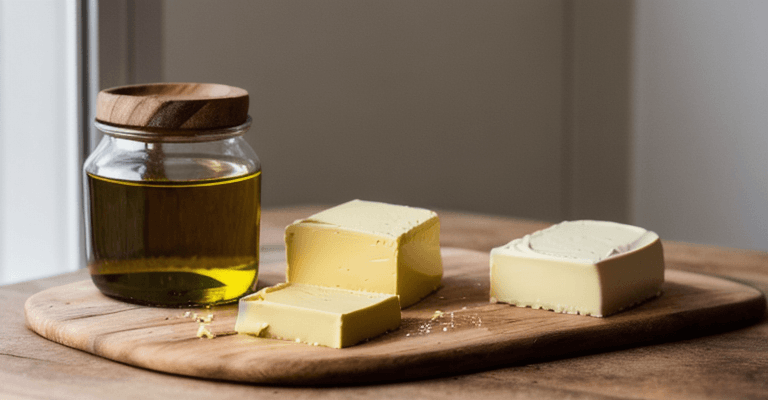
Butter vs Oil in Baking — When to Swap, When Not To, and the Chemistry That Decides
Butter is 80% fat + 15% water + 5% milk solids. Oil is 100% fat. That composition difference changes texture, flavor, browning, and shelf life. Complete swap ratios, fat comparison table, and the science of when each wins.
The composition difference that changes everything
Butter = 80% fat, 15% water, 5% milk solids (casein, whey proteins, lactose). Oil = 100% fat, 0% water, 0% solids. When a recipe says “½ cup butter,” it’s calling for 0.4 cups fat + 0.075 cups water + flavor compounds from milk solids.
This is why the swap ratio is not 1:1 by volume. Use ¾ the amount of oil to replace butter, or the result will be greasy. The missing water matters too — butter’s water content creates steam during baking, contributing to lift in cakes and flakiness in pastry.
| Fat Source | Total Fat % | Water % | Milk Solids % | Saturated Fat % | Smoke Point |
|---|---|---|---|---|---|
| Butter (regular) | 80% | 15% | 5% | 63% of fat | 150°C (302°F) |
| Clarified butter / ghee | 99% | <1% | <1% | 63% of fat | 252°C (485°F) |
| Coconut oil (refined) | 100% | 0% | 0% | 82% of fat | 204°C (400°F) |
| Vegetable oil (canola) | 100% | 0% | 0% | 7% of fat | 204°C (400°F) |
| Olive oil (extra virgin) | 100% | 0% | 0% | 14% of fat | 190°C (375°F) |
| Avocado oil | 100% | 0% | 0% | 12% of fat | 271°C (520°F) |
Key finding: The saturated fat percentage determines whether a fat is solid at room temperature. Butter and coconut oil are solid because >50% of their fatty acids are saturated. This solidification is what creates structure in baked goods — and why liquid oils produce fundamentally different textures.
When oil wins — and the science behind it
Moist cakes and quick breads. Oil doesn’t solidify at room temperature. A cake made with oil stays soft for days because the fat remains liquid inside the crumb. Butter cakes firm up as the butter resolidifies after cooling. This is why grocery store muffins (made with oil) stay soft for a week while homemade butter muffins get dense after 2 days.
Recipes where butter flavor doesn’t matter. Chocolate cake, carrot cake, banana bread, spice cakes — the other flavors dominate. Oil adds moisture without competing.
High-heat applications. Butter burns at 150°C because the milk solids undergo Maillard reactions and then carbonize. Neutral oils handle 190–230°C before degrading. For frying, searing, or very hot oven applications, oil won’t burn. Ghee solves this by removing the milk solids — same butter flavor base, 252°C smoke point.
Dairy-free baking. The only reason to swap in many cases. Use a 1:1 weight ratio of coconut oil for butter if you need a solid fat (pie crust, cookies). Use liquid oil at ¾ ratio for cakes and quick breads.
When butter wins — and no substitute exists
Flaky pastry. Pie crust, croissant dough, puff pastry, biscuits — these depend on cold butter pieces melting during baking and creating steam pockets from the water content. Oil distributes evenly and cannot create layers. Coconut oil can partially substitute (solid at room temp) but lacks the water content that creates steam-leavened layers.
Cookies with structure. Creaming cold butter with sugar traps air bubbles in the solid fat matrix. These bubbles expand during baking and give cookies their lift and texture. Oil cookies spread flat because there’s no creaming step and no air pockets. This is physics, not preference.
Browning and flavor development. Butter’s milk solids are 5% of the total weight but 90% of the flavor. Casein and lactose undergo Maillard reactions at 120–150°C, creating hundreds of flavor compounds (diacetyl, lactones, butyric acid derivatives). Brown butter pushes this further — the solids caramelize into nutty, toasted compounds that no oil can replicate.
Flavor-forward baked goods. Shortbread, pound cake, butter cookies, brioche — these showcase butter. Substituting oil removes the point.
Complete swap table — by weight and volume
| Butter Amount | Oil Equivalent (volume) | Oil Equivalent (weight) | Additional Adjustments |
|---|---|---|---|
| 2 tbsp (28g) | 1.5 tbsp oil | 21g oil | Add pinch salt if using unsalted recipe |
| ¼ cup (57g) | 3 tbsp oil | 43g oil | — |
| ⅓ cup (76g) | ¼ cup oil | 57g oil | — |
| ½ cup (113g) | 6 tbsp oil | 85g oil | Add 1 tsp water |
| ⅔ cup (151g) | ½ cup oil | 113g oil | Add 1 tbsp water |
| 1 cup (227g) | ¾ cup oil | 170g oil | Add 1 tbsp water to compensate for butter’s water content |
| 1.5 cups (340g) | 1 cup + 2 tbsp oil | 255g oil | Add 1.5 tbsp water |
The math: Butter is 80% fat. Oil is 100% fat. To get the same fat content: oil amount = butter amount × 0.75. For the missing water: add ~1 tbsp water per cup of butter replaced.
What changes when you swap — the full comparison
| Property | With Butter | With Oil | Why |
|---|---|---|---|
| Texture | Firmer, more structured | Softer, more tender | Saturated fat solidifies at room temp |
| Crumb structure | Tighter, defined air pockets | More uniform, moister | Creaming creates discrete bubbles; oil coats evenly |
| Moisture at day 1 | Peak moisture | Peak moisture | Both deliver comparable hydration initially |
| Moisture at day 3 | Declining (fat resolidifies) | Stable | Oil remains liquid inside crumb |
| Flavor | Buttery, rich, complex | Neutral | Milk solids carry 90% of butter’s flavor |
| Browning | More (milk solids = Maillard) | Less | No proteins/sugars to react in oil |
| Flakiness | Possible (cold layers) | Impossible | Requires solid fat + water steam |
| Shelf life | 2–3 days peak | 4–5 days peak | Liquid fat = sustained moisture |
| Rise from fat | Moderate (air from creaming) | Minimal (no air entrapment) | Creaming requires solid fat |
| Freezer stability | Good (6 months) | Good (6 months) | Both freeze well |
The never-swap list
These recipes fail structurally without butter — not just in flavor, but in physics:
- Pie crust — butter is structural (cold fat layers → steam → flake). Oil makes a crumbly, mealy crust.
- Croissants / puff pastry — lamination requires a solid fat that melts during baking. Oil has no solid phase.
- Shortbread — the recipe is flour + sugar + butter. Remove butter and the recipe doesn’t exist.
- Buttercream frosting — requires whipping air into solid fat. Oil won’t hold air bubbles.
- Brioche — butter incorporated into enriched dough creates the specific tender-but-structured crumb. Oil brioche is just soft bread.
The hybrid approach
Professional bakers often use both: butter for flavor and structure, oil for moisture retention. A cake with ¼ cup butter (creamed with sugar for lift) plus 2 tbsp oil (for staying moist) outperforms either fat alone. The butter provides flavor and initial structure; the oil prevents the crumb from drying out over 3–5 days.
The ratio that works: Replace up to 25% of the butter with oil in cake recipes without noticeably losing structure. Beyond 25%, the crumb becomes too soft and the cake may not hold its shape when sliced.
Fat substitution effects by recipe type
The impact of swapping butter for oil depends entirely on the recipe category. Some swaps are invisible; others fundamentally change the result. This table captures realistic outcomes by recipe type.
| Recipe | Best Butter Substitute | Texture Change | Flavor Change | Moisture Adjustment |
|---|---|---|---|---|
| Chocolate cake | Neutral vegetable oil (canola, sunflower) | Softer, moister crumb; stays fresh 2 days longer | Undetectable — cocoa dominates | Add 1 tbsp water per cup of butter replaced |
| Banana bread | Coconut oil (melted) or canola oil | Slightly denser but moister; less crumbly | Coconut oil adds faint sweetness; canola is neutral | No adjustment needed — banana provides moisture |
| Sugar cookies | Coconut oil (solid, creamed with sugar) | Softer, less snap; spread slightly more | Mild coconut note unless refined | Reduce liquid by 1 tsp per cup — coconut oil melts faster |
| Carrot cake | Any neutral oil | Nearly identical to butter version | Undetectable — spices dominate | Add 1 tbsp water per cup of butter replaced |
| Blueberry muffins | Canola or avocado oil | Tender, moist; slightly less domed top | Neutral — fruit flavor carries | Add 1 tsp water per ½ cup butter replaced |
| Cornbread | Bacon fat or lard | Crispier edges, tender center | Savory depth that butter cannot match | No adjustment — lard is 100% fat like oil |
The pattern: In recipes where other flavors dominate (chocolate, spice, fruit, savory elements), the swap is nearly invisible. In recipes where butter IS the flavor (shortbread, pound cake, butter cookies), no substitute works because you are removing the defining ingredient.
For dairy-free baking specifically, coconut oil in its solid state is the closest functional match to butter — it creams with sugar, creates flaky layers when cold, and solidifies at room temperature. The limitation is flavor: even refined coconut oil carries a faint sweetness that butter does not.
When substitution fails
Some baking applications require butter not as a flavor preference but as a structural necessity. No oil or alternative fat can replicate these functions.
Laminated doughs require real butter. Croissants, puff pastry, and Danish pastry depend on a block of cold butter folded between layers of dough. During baking, the butter melts and its 15% water content converts to steam, puffing each layer apart. Oil cannot be folded into layers (it is liquid). Coconut oil can be sheeted cold, but it melts at 24°C — 8°C lower than butter — so it leaks out of the dough during the final proof in a warm kitchen. Margarine designed for lamination (with a melting point of 34–38°C) is the only professional-grade substitute, and even that produces flatter, less flaky results.
Flavor compounds cannot be replicated. When butter browns at 120–150°C, milk solids undergo Maillard reactions producing over 230 identified volatile flavor compounds — including diacetyl (buttery aroma), delta-decalactone (creamy, peach-like), and butyric acid (sharp, cheese-like in small amounts). No plant-based fat contains the proteins and lactose needed for these reactions. “Butter flavoring” added to oils replicates perhaps 3–5 of these 230+ compounds. The gap is immediately detectable in simple recipes like brown butter sage sauce or financiers.
Temperature behavior differs fundamentally. Butter transitions from solid to liquid across a range of 25–35°C — a gradual melt that gives cookies their spread pattern and cakes their crumb structure. Coconut oil melts sharply at 24°C (solid to liquid in a 2°C window). Liquid oils have no transition at all. This means creaming butter with sugar traps air across a controlled temperature range; no substitute replicates that mechanical air incorporation at the same efficiency. Cookies made with oil spread flat because there is no solid-fat matrix to hold air bubbles during the first minutes of baking.
